Info Hot Job Find your dream job! Get for jobs, post your resume, compare salaries and find career advice and research.
Software Developer Vs Software Engineer: Why the Job Title Doesn’t Tell the Whole Story
A Software Developer and a Software Engineer can spend their days solving similar problems, writing similar code, and building the same kind of product. That’s why comparing the titles alone can be misleading. Behind those familiar names, employers often expect different levels of ownership and technical responsibility.
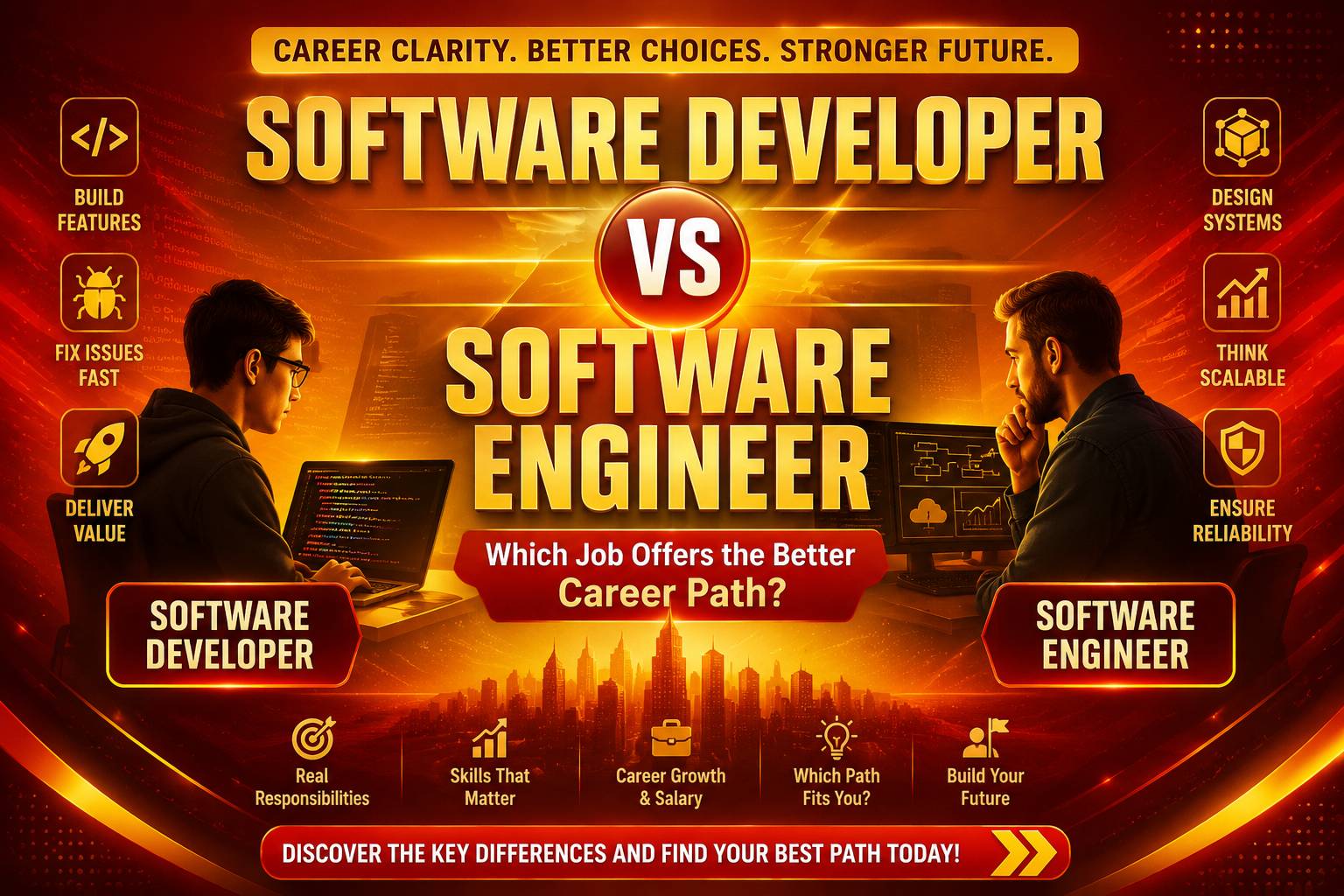
A Software Developer commonly focuses on creating, improving, and maintaining software. The role may involve building new features, fixing bugs, connecting applications with external services, testing functionality, and refining software after release. Much of the work stays close to what the product needs at that moment.
A Software Engineer may take a wider view. Writing code is still part of the job, but decisions about architecture, reliability, performance, scalability, and how separate parts of a system work together can carry more weight. As systems grow, those choices can shape the work in ways that aren’t obvious from the job title.
There isn’t a universal hierarchy between the two. One company may expect its developers to design major systems, while another gives that responsibility primarily to engineers. Relying on the title alone can cause job seekers to overlook a strong opportunity or accept a position that doesn’t match their expectations.
Software Developer Vs Software Engineer Responsibilities and Daily Scope
The difference in Software Developer Vs Software Engineer usually becomes clearer once the actual work begins. Developers often stay closely involved with application features and product requirements. They turn ideas into working software, investigate issues, improve existing code, and help keep releases on track.
Development work also involves choices made before the first line of code is written. Teams need to consider how a feature should behave, how users will interact with it, and whether the technical approach can support the intended result. The relationship between implementation and planning is closely tied to software development and design, particularly when a project requires a durable solution rather than a quick fix.
Engineers may work on the same features while taking responsibility for a broader technical environment. They can examine how services communicate, identify performance risks, or evaluate whether a design will remain maintainable as the product expands.
Picture a growing online platform. A developer could build a customer dashboard and connect it to backend services. An engineer on the same platform might focus on how those services exchange data, recover from failures, and support a much larger number of users. The responsibilities overlap, but the scope of the decisions can differ.
Specialized roles can make that difference easier to see. A Firmware Development Engineer position at Intel, for instance, may require lower-level programming knowledge and experience working closer to hardware environments. In this kind of position, the technical domain often says more about the work than the word Developer or Engineer alone.
Software Developer Vs Software Engineer Skills and Technical Expectations
Both career paths depend on solid programming fundamentals. Employers generally look for people who can write maintainable code, debug effectively, test their work, use version control, and break down technical problems without overcomplicating straightforward issues.
Differences tend to appear when software extends beyond a single application or service. Engineering-focused positions may require deeper experience with system design, algorithms, data structures, concurrency, performance, and scalability. Developers can work extensively in these areas as well, particularly at senior levels, so the title remains an imperfect measure of technical depth.
Specialization often provides a clearer signal. Java Software Engineer opportunities, for example, can combine language expertise with enterprise architecture, backend systems, and complex business logic. Job seekers can learn more from those technical requirements than from assuming every Software Engineer role follows the same pattern.
Technical ability alone rarely determines long-term progress. Developers and engineers also need to explain trade-offs, review code, challenge weak assumptions, and work effectively with product managers, designers, testers, and other technical teams. Strong solutions have limited value if the people involved can’t understand why a particular approach was chosen.
Job titles become less meaningful when compared with the actual level of ownership. A developer responsible for difficult systems can gain more valuable experience than an engineer limited to repetitive tasks. Complexity, decision-making, and responsibility usually provide a clearer picture of career value.
Software Developer Vs Software Engineer Career Growth and Job Opportunities
Compensation can vary between Software Developer and Software Engineer positions, but the title itself doesn’t determine who earns more. Location, industry, seniority, specialization, company size, and technical ownership often have a greater influence on salary.
Career progression is equally flexible. A Software Developer can move toward senior development, technical leadership, architecture, or management. A Software Engineer may advance to Senior, Staff, or Principal Engineer roles while taking on increasingly complex technical decisions. Many organizations create significant overlap between these paths as professionals gain experience.
Professionals who want to move toward leadership may eventually pursue positions such as Director of Software Development. Roles at that level shift attention from individual implementation toward delivery, engineering teams, technical direction, and broader business outcomes.
Large technology environments can further blur the distinction between development and engineering. A Software Development Engineer role at Audible can involve building software while meeting broader expectations around quality, performance, collaboration, and long-term technical ownership.
Choosing between the two should come down to the work itself. Developers who enjoy building and refining product features may prefer roles centered on implementation. Professionals drawn to architecture, system behavior, and larger technical challenges may find engineering-focused positions more appealing. The responsibilities, growth potential, and technical depth deserve more attention than which title sounds more prestigious.
FAQ Software Developer and Software Engineer Careers
- Is a Software Engineer higher than a Software Developer?
Not necessarily. There is no universal job hierarchy that automatically places a Software Engineer above a Software Developer. Some companies use the titles almost interchangeably, while others give engineers broader responsibility for system architecture, scalability, reliability, and technical design. Seniority, ownership, decision-making authority, and the complexity of the systems involved offer a more accurate way to compare positions than the title alone.
- Which is better for a career, Software Developer or Software Engineer?
Neither title guarantees a better career because the value of a role depends on the experience it provides. A Software Developer can build strong long-term experience by owning complex features, improving critical systems, and expanding into architecture or leadership. A Software Engineer may suit professionals interested in large-scale systems and technical design, but the responsibilities, learning opportunities, and room for growth should carry more weight than the wording of the title.
- Can a Software Developer become a Software Engineer?
Yes. Moving between these titles is common because companies define software positions differently, and responsibilities often change as experience grows. Developers can move toward engineering-focused work by strengthening skills in system design, architecture, scalability, testing, performance, and technical decision-making. Employers generally place greater value on proven ability, meaningful project ownership, and experience solving complex problems than on the exact title used in a previous role.
The Software Developer Vs Software Engineer decision shouldn’t rest on which title sounds more prestigious. Both paths can lead to strong technical careers and increasing responsibility, but the real distinction comes from the work involved. Evaluate the problems you’ll solve, the systems you’ll influence, and the ownership the role provides before deciding which opportunity represents the stronger next step.