Info Hot Job Find your dream job! Get for jobs, post your resume, compare salaries and find career advice and research.
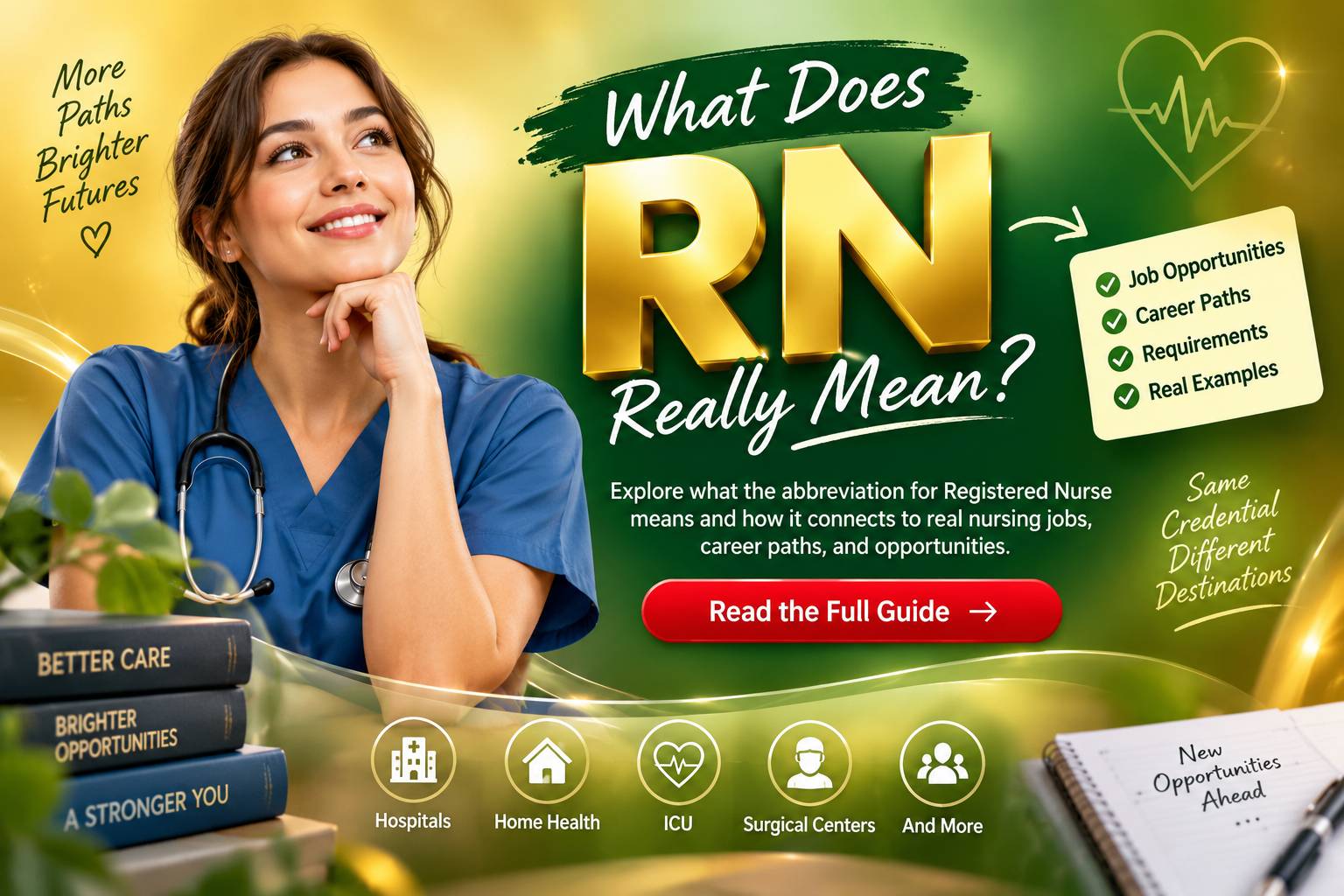
Three letters show up everywhere in American healthcare: RN. You’ll find them after a nurse’s name, in hospital vacancies, on résumés, and across healthcare employment sites. The abbreviation is familiar, yet its significance is easy to overlook. For nurses looking for work, knowing what RN represents can make job listings easier to understand, especially when two positions carry the same designation but offer very different responsibilities.
Abbreviation For Registered Nurse: What Does RN Mean?
The standard abbreviation for Registered Nurse is RN. In the United States, it identifies a nurse who has completed the required education, passed the applicable licensing examination, and met the requirements to practice as a registered nurse.
“RN” may appear after a professional’s name, such as “Jane Smith, RN,” or directly in a job title such as “Staff RN.” Either way, it refers to the registered nursing designation.
Registered nurses can assess patients, plan and provide nursing care, administer medications and treatments within their scope of practice, maintain clinical records, educate patients, and coordinate care with physicians and other healthcare professionals. The exact duties depend on state law and the clinical setting.
Licensure is a central part of the designation. A nurse must satisfy the requirements of the state where they practice, while an employer can add qualifications based on the position. One facility may prioritize specialty experience, for example, while another may place greater emphasis on certifications or previous experience with a particular patient population.
Basic Life Support is another requirement that can appear in clinical nursing vacancies. The BLS requirements for Registered Nurse positions provide an example of how an RN credential can be accompanied by additional workplace qualifications.
RN Abbreviation in Nursing Jobs
Employers use RN in job titles because it immediately identifies the professional credential they need. A vacancy might be called “RN,” “Staff RN,” “ICU RN,” or “Home Health RN.” The wording varies, but the registered nursing qualification remains the foundation of the position.
The title alone, however, doesn’t tell an applicant what the work will involve. A medical-surgical RN may care for patients with a broad range of conditions, while an ICU RN may manage patients who need continuous monitoring and complex interventions. Experience, certifications, clinical skills, and familiarity with specific equipment or systems can all become important during recruitment.
The setting can change the job just as much. Hospital nurses generally work within a large multidisciplinary team, whereas home health nurses often make clinical decisions with less immediate support at the bedside. A Home Health RN opportunity in Boynton Beach shows how the same RN qualification can lead to a community-based role rather than a hospital position.
Geography matters, too. Nurses still have to satisfy state licensing rules, but local employers can have different staffing needs, hiring standards, and preferred qualifications. A Registered Nurse opportunity in the Bronx represents a different employment environment from a home care position in Florida.
For someone applying to RN jobs, those details are more useful than the abbreviation itself. The title tells you the professional level. The rest of the posting tells you whether the job fits your experience, availability, and career direction.
Registered Nurse Abbreviation on Resumes and Career Paths
On a résumé or professional profile, RN lets recruiters identify a registered nursing credential quickly. Writing “Registered Nurse (RN)” when the qualification is first mentioned is clear and professional; using RN afterward keeps the document concise.
That credential can lead in several directions. Some nurses stay focused on direct patient care and build expertise in a particular specialty. Others move into case management, education, leadership, perioperative services, community health, or other areas where clinical experience remains valuable.
Specialization can also open the door to advanced nursing practice. A Certified Registered Nurse Anesthetist, commonly abbreviated CRNA, requires advanced education and professional certification beyond the basic RN credential. A CRNA opportunity at Madison Street Surgery Center in Denver illustrates one of the more specialized career paths available within nursing.
Not every nurse moves away from bedside care. Many develop extensive expertise while remaining in direct clinical practice. Critical care is one example, where nurses must recognize subtle changes in a patient’s condition, respond quickly, and manage complex care. A Staff Registered Nurse role in a Cardiovascular/ICU setting in Houston reflects that demanding side of RN employment.
So, while RN tells you the professional credential, it doesn’t tell you the whole story. The specialty, patient population, work environment, shift, experience requirements, and employer expectations determine what the position actually looks like day to day. That’s why nurses comparing vacancies should look past the title before deciding where to apply.
FAQ Abbreviation For Registered Nurse
- What is the correct abbreviation for Registered Nurse?
The standard abbreviation for Registered Nurse is RN. It’s widely recognized throughout the United States and appears in professional credentials, résumés, healthcare records, employment listings, and other nursing-related documents. When RN follows a nurse’s name, it identifies the registered nursing designation, provided the nurse maintains the license required to practice in the applicable jurisdiction. - Is RN the same as Registered Nurse on a job application?
Yes. RN is the accepted abbreviation for Registered Nurse, so an employer that lists an “RN position” is generally seeking a registered nurse. The important point is that the abbreviation doesn’t describe the entire position. Employers can set different requirements for experience, certifications, clinical skills, schedules, and specialty knowledge, even when two vacancies both use the RN title. - Why do employers use the RN abbreviation in nursing job titles?
RN is short, widely understood, and immediately communicates the professional credential required for a position. That’s why employers commonly use titles such as “Staff RN,” “ICU RN,” and “Home Health RN.” The specialty or work setting is usually added to distinguish the role, while the full job description provides the details applicants need before deciding whether they meet the employer’s requirements.
The abbreviation for Registered Nurse is RN, but those two letters represent a regulated professional credential that applies to a remarkably broad range of healthcare work. An RN may build a career in a hospital, home health, surgical center, intensive care unit, or another clinical environment, with responsibilities changing substantially from one position to another. For nurses searching for employment, recognizing RN is useful, but understanding the license, specialty, experience, and workplace expectations behind each vacancy is what makes the job search more precise.