Info Hot Job Find your dream job! Get for jobs, post your resume, compare salaries and find career advice and research.
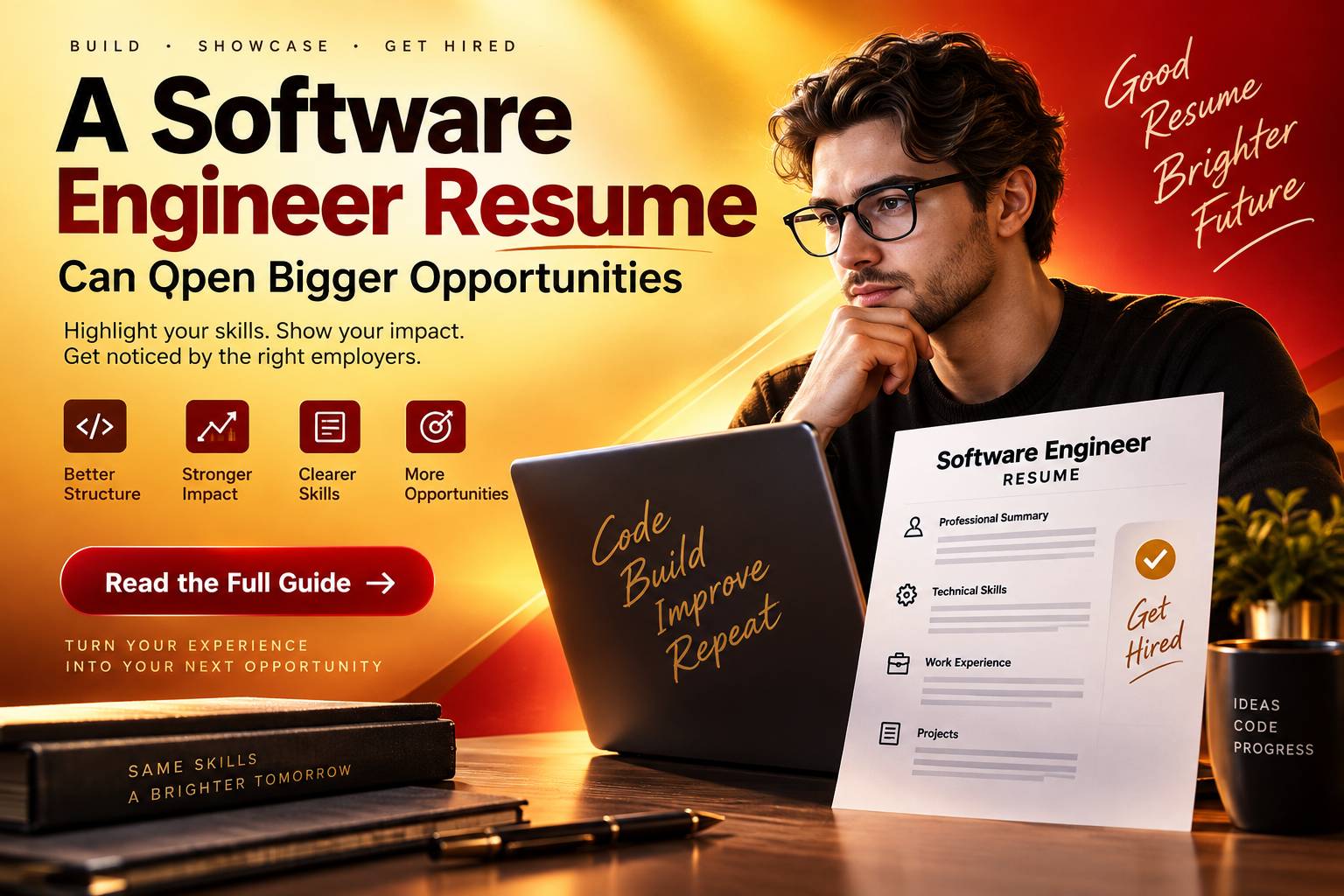
A strong software engineer resume has to prove more than your ability to write code. Recruiters need to recognize your value quickly, often while reviewing dozens of applications for the same opening. A page crowded with programming languages and generic job duties won’t necessarily stand out. What matters is the evidence behind those skills: the systems you built, the problems you solved, and the results your work produced.
Software engineering hiring has become more selective, too. Companies need people who can turn requirements into dependable products, work through technical challenges, and contribute to decisions beyond individual lines of code. That changes how you should write a resume. Your experience needs context, your skills need purpose, and the document should make your contribution easy to understand.
Software Engineer Resume Format That Gets Noticed
A well-structured Software Engineer Resume typically begins with a concise professional summary, followed by technical skills, work experience, projects, education, and other qualifications that support the role. This arrangement gives recruiters a familiar path through the document while keeping important information easy to find.
The summary deserves careful wording. Generic claims such as “hard-working software engineer” or “excellent problem solver” take up space without revealing much about your capabilities. A stronger summary identifies your engineering specialty and the systems you’ve worked with. A backend engineer, for instance, might mention API development, database optimization, distributed systems, cloud infrastructure, or scalable application architecture.
The experience section usually carries the most weight. A job description shouldn’t read like a list copied from an employment contract. “Developed web applications” is too broad to show what you actually accomplished. A better description adds context and explains the impact. Perhaps you improved response times, automated a manual process, strengthened reliability, lowered infrastructure costs, or delivered a major feature. Those details give a recruiter something concrete to evaluate.
Projects can provide another layer of proof, particularly for entry-level engineers and candidates changing specialties. A personal or academic project involving authentication, databases, APIs, cloud deployment, testing, or system architecture can demonstrate practical ability. Give the project some context by explaining what you built and the technical decisions behind it rather than dropping its name into a skills list.
Keep the design straightforward. A readable single-column layout, consistent headings, and sensible spacing are usually enough. Heavy graphics and complicated formatting can make important information harder to scan and may interfere with applicant tracking systems.
Candidates exploring current opportunities can review software engineer jobs to see how employers describe responsibilities, qualifications, and experience requirements.
Software Engineer Resume Skills and Experience
A technical skills section works best when it reflects your actual background. Depending on the position, that might include Python, Java, JavaScript, C++, Go, or C#, together with frameworks, databases, cloud platforms, testing tools, development environments, and version-control systems.
There’s little value in turning this section into a catalog of every technology you’ve encountered. Prioritize tools that relate directly to the job and that you can discuss with confidence. Five technologies supported by meaningful experience tell a clearer story than twenty names with no explanation behind them.
Your work history should also show how your responsibilities have developed. Early roles may center on implementing features or fixing defects. Later positions might involve service ownership, architecture decisions, performance improvements, technical leadership, or cross-functional planning. That progression gives employers a clearer picture of how your engineering scope has expanded.
Specific language makes a difference. “Maintained PostgreSQL databases” describes a duty. “Optimized PostgreSQL queries and indexing strategies to improve application response times” gives the reader a much better sense of the work involved. Real measurements make such statements stronger when they’re available. Improvements in latency, deployment speed, reliability, cost, or user experience can provide valuable evidence of impact.
Industry can shape those expectations, too. A position such as Rockwell Collins software engineer in Richardson, TX shows how engineering requirements can differ according to the systems, customers, and development environment involved. Candidates should give greater visibility to experience that matches the kind of work they want to pursue.
Software isn’t limited to conventional business applications. Engineers also build specialized products for particular industries and user groups. Free landscape design software, for example, combines visualization, interaction, specialized workflows, and user-focused functionality. From a resume perspective, experience with this type of product can demonstrate how engineering skills are applied to a specific user problem.
A similar example appears in T-shirt design software, where product functionality can involve graphical interfaces, customization, image handling, file formats, and user-driven workflows. The industry itself isn’t the main point. What matters is the engineering challenge behind the product and the way you contributed to solving it.
Resume targeting is another important consideration. Someone applying for cloud infrastructure work should bring cloud architecture, automation, monitoring, containers, or infrastructure-as-code closer to the foreground. A frontend position may call for more emphasis on React, TypeScript, accessibility, performance, and interface architecture. Your career history doesn’t need to change; the emphasis does.
Employer context can matter just as much. An opportunity such as Advent Software Inc. software engineer in San Francisco illustrates why candidates should consider the company’s industry and development environment when deciding which parts of their background deserve the most attention.
FAQ Software Engineer Resume
- What should a software engineer put on a resume in 2026?
In 2026, a software engineer resume should focus on relevant technical experience, measurable accomplishments, current development practices, and technologies that match the target role. Programming languages still matter, but they don’t tell the whole story. Employers also look for evidence of problem-solving, system design, testing, cloud platforms, automation, security awareness, collaboration, and the ability to deliver dependable software in a real production environment. - How long should a Software Engineer Resume be?
One page can work well for a junior engineer or someone with limited professional experience. Candidates with several years of engineering work, substantial projects, or specialized expertise may need two pages to present their background properly. There’s no benefit to adding content simply to make a resume longer. Each section should provide useful evidence about skills, accomplishments, responsibilities, or qualifications connected to the job. - Should a Software Engineer Resume include AI and cloud skills?
AI and cloud skills are worth including when they’re genuinely connected to the role and supported by hands-on experience. Simply adding AWS, Azure, artificial intelligence, or machine learning as keywords won’t make a resume more convincing. A stronger approach is to describe what you actually built, deployed, automated, or improved. Concrete examples give those technologies context and make your capabilities easier to evaluate.
A good Software Engineer Resume makes the connection between technical ability and real work unmistakable. It shows what you know, where you’ve applied it, and what came from that work. Clear writing and meaningful evidence will carry more weight than a crowded skills section. When every part of the resume supports the position you’re pursuing, the document becomes easier to understand and much less likely to blend into a stack of generic applications.