Info Hot Job Find your dream job! Get for jobs, post your resume, compare salaries and find career advice and research.
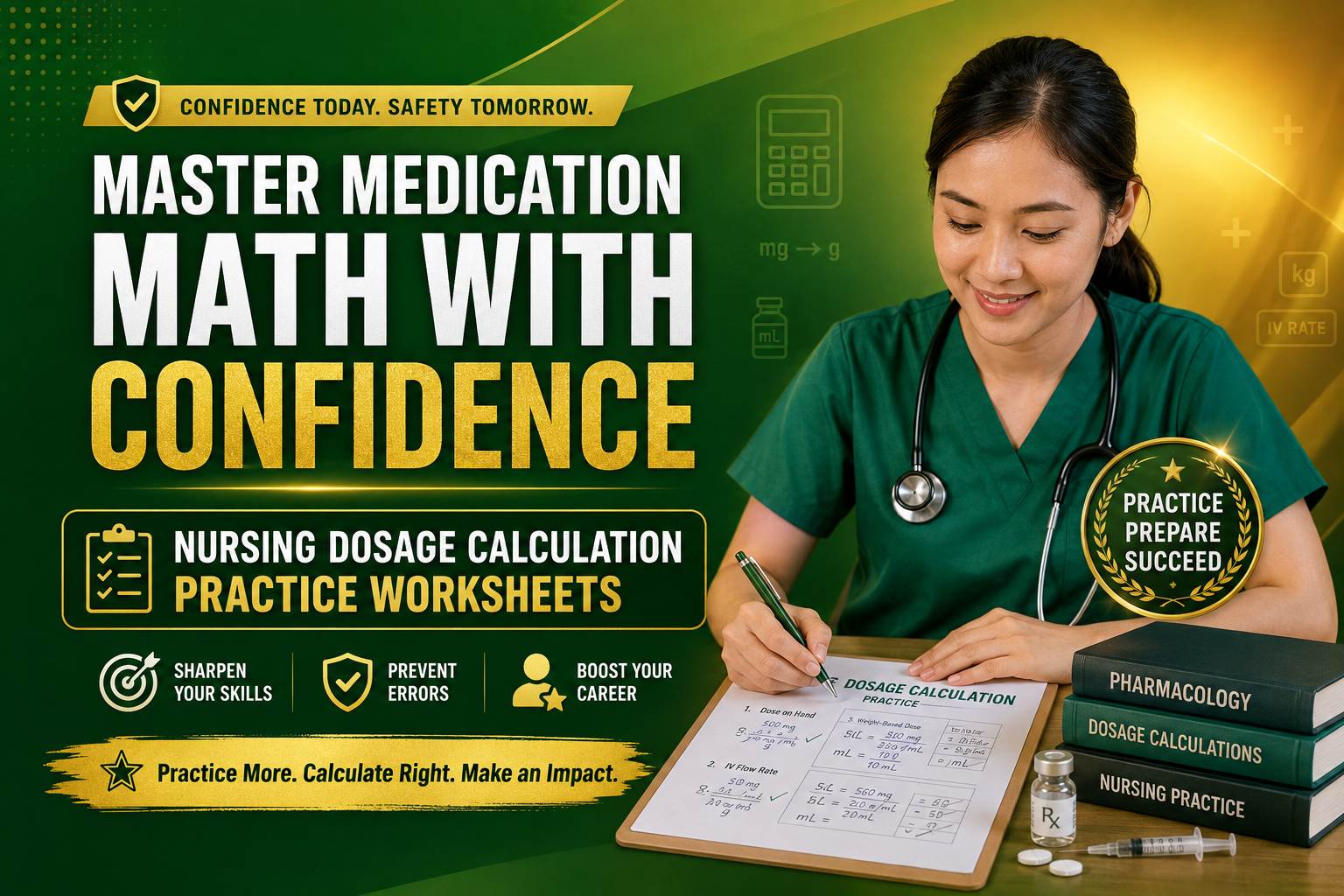
Medication errors don’t wait for a nurse to feel ready. A busy shift, a new prescription, a decimal point, or a conversion between units can turn basic arithmetic into a high-stakes clinical decision. For nursing students and new nurses, accuracy with dosage calculations isn’t just another classroom requirement. It’s a job skill that directly affects patient safety, professional confidence, and employability.
That’s where Nursing Dosage Calculation Practice Worksheets can make a real difference. Repeated practice creates a more reliable calculation process, especially when questions involve tablets, liquid medications, weight-based dosing, IV rates, or unit conversions. The goal isn’t to memorize endless formulas. It’s to develop the ability to read an order carefully, identify the relevant information, calculate the dose, and recognize when an answer doesn’t make clinical sense.
Why Nursing Dosage Calculation Practice Worksheets Matter for Nursing Jobs
Nursing schools often use dosage calculation tests to determine whether students are ready for clinical practice. Employers expect the same basic competency, even when they don’t administer a formal calculation exam during hiring. A nurse who struggles with medication math may have difficulty working efficiently in an environment where medication administration is part of every shift.
Nursing Dosage Calculation Practice Worksheets provide a controlled way to build that competency before the pressure of a real clinical setting. A student can work through a problem, identify an error, correct the calculation, and repeat the process until the method becomes consistent.
That consistency matters. A nurse may need to calculate a medication dose while managing multiple patients, responding to interruptions, checking an electronic medication record, and communicating with other members of the healthcare team. The arithmetic itself may be simple, but the working environment isn’t.
Practice also helps nurses recognize common calculation traps. Converting milligrams to grams, interpreting milliliters correctly, calculating a dose based on kilograms, or determining an IV flow rate requires attention to detail. A worksheet can isolate those skills and allow focused repetition instead of forcing every calculation into a high-pressure clinical situation.
For anyone pursuing nursing employment, this preparation has a practical advantage: confidence. A nurse who can perform calculations accurately and verify the result is better positioned to handle medication administration without unnecessary hesitation.
Nursing Dosage Calculation Practice Worksheets for Different Medication Problems
Not every dosage calculation follows the same pattern. Some problems require a straightforward dose-on-hand calculation, while others involve several steps. Effective Nursing Dosage Calculation Practice Worksheets should reflect the range of problems nurses encounter during education and clinical practice.
Tablet and capsule calculations are usually among the most familiar examples. The nurse compares the prescribed dose with the strength available and determines how much medication should be administered. Liquid medications introduce another variable because the concentration is often expressed as a specific amount of medication per milliliter.
Weight-based calculations demand another level of attention. Pediatric and critical-care medications, for example, may be prescribed according to kilograms of body weight. The calculation can require the nurse to determine the patient’s weight in the correct unit before calculating the prescribed dose.
IV calculations can become more involved. Nurses may need to determine an infusion rate, calculate the volume remaining, or convert between units of time. These problems reinforce an important principle: the final number should always be evaluated against the clinical context.
A correct calculation isn’t automatically a safe medication administration. The medication order, patient identity, medication concentration, route, timing, allergies, and other relevant safety checks still matter. Dosage practice supports clinical judgment; it doesn’t replace it.
How Dosage Calculation Practice Supports Nursing Career Readiness
The connection between medication math and employment is easy to overlook when studying for nursing school. Students often focus on passing an exam, but the underlying skill continues into professional practice.
A newly licensed nurse may enter a hospital, outpatient clinic, long-term care facility, emergency department, or another healthcare setting where medication administration is routine. Each environment has its own workflow, but the expectation for accurate medication calculations remains.
Regular practice can also reduce the cognitive load associated with common calculations. When a nurse has repeatedly worked through similar problems, the process becomes more familiar. That doesn’t mean calculations should become automatic or careless. Quite the opposite: familiarity allows more attention to be directed toward verification and patient-specific factors.
For students preparing for employment, dosage calculation practice should sit alongside clinical preparation, nursing knowledge, communication skills, and interview readiness. Employers aren’t simply looking for someone who can solve an equation. They need nurses who can apply knowledge carefully under real working conditions.
Students preparing for advanced nursing careers may also benefit from understanding how education progresses beyond initial licensure. Information about Doctor of Nursing Practice salary expectations can provide useful career context for nurses considering advanced practice or leadership pathways.
Those considering graduate-level education can also explore Doctorate of Nursing Practice programs and career pathways.
Strong academic preparation often begins before nursing school admission. Students preparing for entrance testing can use a Kaplan nursing entrance exam practice test to become more comfortable with the testing environment and question format.
Additional Kaplan nursing entrance exam practice questions can provide another opportunity to identify weak areas before test day.
For nurses interested in anesthesia, medication calculations become especially relevant to a broader clinical knowledge base. Reviewing nurse anesthetist education requirements can help clarify the education and preparation involved in this advanced nursing career.
A structured dosage calculation workbook can also provide convenient practice material for students who prefer working through problems away from a computer. Nursing dosage calculation practice materials can complement classroom exercises and provide additional repetition.
FAQ Nursing Dosage Calculation Practice Worksheets
1. How often should nursing students use dosage calculation practice worksheets?
There isn’t one universal schedule that works for every nursing student, but consistent short practice sessions are generally more useful than occasional marathon sessions. Working through dosage calculations several times each week can reinforce conversions, formulas, and verification habits. Students should increase practice before dosage exams, clinical rotations, and other assessments where medication calculation accuracy is evaluated.
2. What types of problems should Nursing Dosage Calculation Practice Worksheets include?
Useful worksheets should cover more than basic tablet calculations. Students benefit from practicing liquid medication doses, unit conversions, weight-based dosing, IV flow rates, infusion calculations, and problems that require multiple steps. The strongest practice also includes realistic clinical information so students learn to identify the prescribed dose, available concentration, appropriate units, and reasonable final answer.
3. Can dosage calculation worksheets help prepare nurses for employment?
Yes. While worksheets can’t reproduce every condition of a clinical workplace, they can strengthen the calculation skills nurses use when administering medications. Repeated practice can improve speed, accuracy, and confidence while reducing avoidable arithmetic mistakes. However, employment readiness also requires clinical judgment, medication safety knowledge, communication, documentation, and the ability to follow facility-specific procedures.
Final Thoughts on Nursing Dosage Calculation Practice Worksheets
Nursing Dosage Calculation Practice Worksheets are most valuable when they’re treated as preparation for professional responsibility rather than simply another study assignment. Medication math becomes easier with deliberate repetition, but accuracy remains the priority. Nurses who develop strong calculation habits early carry those habits into clinical practice, where careful decisions can matter far more than a test score. For students working toward their first nursing job, mastering dosage calculations is a practical investment in both competence and confidence.