Info Hot Job Find your dream job! Get for jobs, post your resume, compare salaries and find career advice and research.
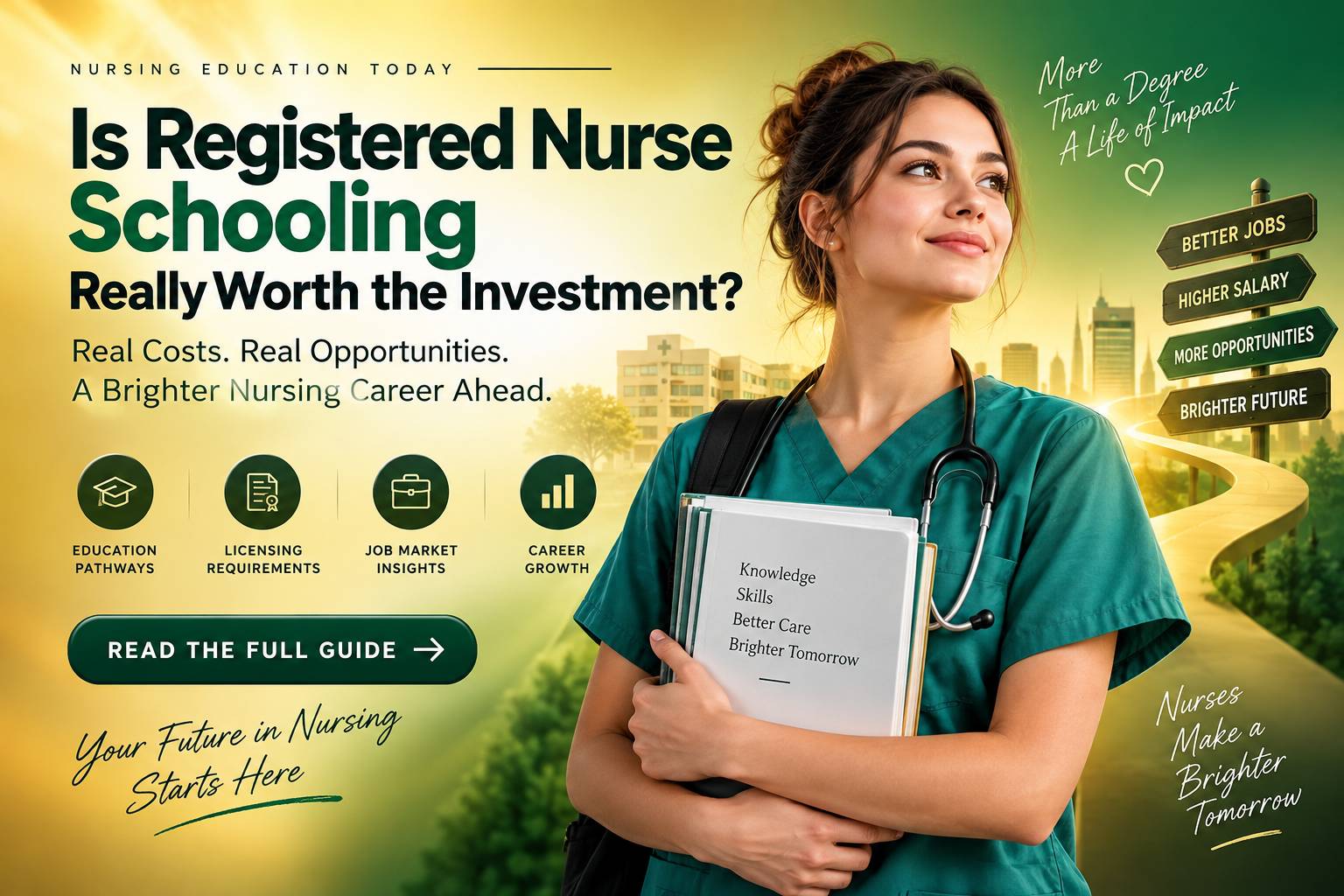
A nursing career starts long before the first shift on a hospital floor. For most people, it begins with demanding coursework, clinical training, exams, and licensing requirements. Registered Nurse Schooling can take a significant investment of time and money, so choosing a program shouldn’t be treated as a routine college decision.
What matters is what that investment delivers. A nursing program should do more than help students finish their coursework. It needs to prepare them to care for patients safely, meet licensing requirements, and compete for actual nursing positions after graduation. The quality of that preparation can make a noticeable difference once school is over.
What Registered Nurse Schooling Really Requires
Registered Nurse Schooling combines academic study with supervised clinical experience. Students spend considerable time learning subjects such as anatomy, physiology, pharmacology, medical-surgical nursing, mental health, maternal and newborn care, and community health. The material isn’t just theoretical. Much of it eventually becomes part of everyday clinical decision-making.
Clinical training brings another level of pressure. A student might know the correct procedure from a textbook and still hesitate when faced with an anxious patient, an unexpected change in vital signs, or several competing priorities. Clinical rotations help develop judgment, communication, documentation, medication-safety habits, and teamwork while students are still working under supervision.
That practical experience should carry real weight when comparing nursing programs. Tuition may be the first number prospective students see, but accreditation, clinical placement, graduation outcomes, licensing eligibility, and preparation for the licensing examination can have a much greater effect on the education’s long-term value.
Cost deserves the same scrutiny. Tuition isn’t the entire bill. Textbooks, uniforms, equipment, transportation, examination fees, licensing expenses, and income lost while studying can all increase the actual investment. A program that looks inexpensive at enrollment can end up costing considerably more by graduation.
Nursing education can still be a worthwhile investment. The key is to judge it by the career it can realistically support rather than by how quickly a student can complete the program.
Registered Nurse Schooling and the Nursing Job Market
The employment potential of registered nursing is a major reason people enter the field. Nurses work in hospitals, outpatient facilities, rehabilitation, long-term care, home health, community settings, and other healthcare environments. That range gives qualified nurses more than one place to build a career.
Employment data offers a useful reality check. Instead of assuming that nursing automatically means job security, prospective students can look at occupational information, employment trends, and wage data before committing to a program. BLS Registered Nurse Career and Employment Data
A strong overall job market doesn’t mean every new graduate will walk into the exact position they want. Local conditions vary. One area may have plenty of hospital openings but limited opportunities in a particular specialty. Another may offer high wages but require nurses to work less desirable shifts.
This is why completing nursing school shouldn’t be confused with securing a specific job. Registered Nurse Schooling provides the educational foundation and eligibility needed to enter the profession. After that, clinical competence, licensing status, communication skills, experience, and flexibility start to matter much more.
Even the language used in job advertisements can influence a search. Familiarity with common nursing abbreviations and professional terminology makes it easier to understand position descriptions and employer requirements. Registered Nurse Abbreviation Guide
Salary adds another layer to the decision. There isn’t one figure that accurately represents what every registered nurse can earn. Pay varies with state, employer, specialty, experience, and working conditions. Looking at a specific market, such as Colorado, can give prospective nurses a more realistic idea of how location affects earning potential. Registered Nurse Salary in Colorado
For some graduates, that difference may be enough to consider another city or state. The willingness to compare markets can broaden the range of employers and positions available, particularly for nurses who aren’t tied to one geographic area.
Registered Nurse Schooling and Alternative Nursing Jobs
Hospital work is only one option after nursing school. Some registered nurses eventually move into outpatient care, rehabilitation, long-term care, community health, or home healthcare. The right setting often depends on the type of patients a nurse wants to serve and how much independence they prefer in their daily work.
Home healthcare offers a particularly different environment. Rather than caring for patients within a large facility, a nurse may provide services in the patient’s home and manage care with greater day-to-day independence. Registered nurse opportunities with home-care providers show how the profession extends beyond traditional hospital employment. Omni Home Care Registered Nurse Opportunity in Boynton Beach, FL
Geography can widen those choices. A nurse willing to relocate may encounter different employers, specialties, salaries, and staffing conditions. A registered nurse opening with an employer in the Bronx, New York, for example, reflects a different local employment market from one in Florida or Colorado. First Care of New York Registered Nurse Opportunity in Bronx, NY
For students considering the cost of nursing education, this flexibility is worth considering. A credential that can be used across different healthcare settings and geographic markets may offer more career options than one tied to a single type of employer.
Registered Nurse Schooling Cost and Time
The return on nursing education shouldn’t be judged by the first paycheck alone. A more realistic calculation includes tuition and related expenses, the time required to become licensed, employment prospects, expected income growth, and the opportunities available after gaining experience.
Educational pathways differ as well. Some students want a direct route into registered nursing, while others choose a bachelor’s-level program because it fits their longer-term plans. Neither decision should be based solely on speed or prestige. State requirements and individual career goals are more useful criteria.
Time has a financial cost. Each additional semester can mean more tuition and living expenses, while full-time study may limit the ability to earn income. At the same time, trying to shorten the process at the expense of clinical preparation isn’t a sensible trade-off in a profession where mistakes can have serious consequences.
A good program should justify its cost through the preparation it provides. Students can make that judgment by examining licensing eligibility, clinical training, program outcomes, and the employment conditions in the markets where they expect to work.
Registered Nurse Schooling and Career Advancement
Graduation marks the start of professional nursing, not the end of learning. A registered nurse can build experience in different specialties, move between healthcare settings, and pursue additional education when professional goals change.
That flexibility can become valuable over time. Experience in a particular specialty may lead to different positions, while additional credentials or education can support movement into roles with greater responsibility. The opportunities aren’t identical for every nurse, but a solid educational foundation makes future choices easier.
The skills developed during initial training continue to matter years later. Assessment, communication, clinical judgment, documentation, and patient-safety skills form the core of competent nursing practice regardless of where a nurse eventually works.
Career advancement still depends on performance, experience, qualifications, employer requirements, and the opportunities available in a particular market. Schooling can’t promise a specific outcome, but good preparation can leave a nurse with more options when the next opportunity appears.
FAQ: Registered Nurse Schooling Requirements
1. How long does Registered Nurse Schooling usually take?
The length of Registered Nurse Schooling depends on the educational pathway and the licensing requirements of the state where a graduate plans to practice. Some nursing programs can be completed in about two years, while bachelor’s-level programs generally require more time. Students should check current state requirements before enrolling because the chosen program must meet the education criteria for registered nurse licensure.
2. Is Registered Nurse Schooling difficult for students without healthcare experience?
It can be demanding, but previous healthcare employment isn’t necessarily required to enter a nursing program. Students have to manage science courses, nursing theory, examinations, clinical rotations, and hands-on skills, often during the same period. Strong study habits help, but consistency, time management, and the ability to apply classroom knowledge in clinical situations are equally important.
3. Does Registered Nurse Schooling guarantee a nursing job after graduation?
No. Completing an approved nursing program and meeting licensing requirements can qualify a graduate to pursue registered nursing positions, but it doesn’t guarantee employment. Hiring conditions differ by location, specialty, employer, experience, and current demand. Graduates can improve their prospects by preparing carefully for licensure, developing strong clinical skills, and considering a broader range of healthcare settings.
Registered Nurse Schooling can be a worthwhile investment for someone committed to a nursing career, but the return depends on more than earning a credential. Strong education provides meaningful clinical preparation, satisfies licensing requirements, and gives graduates a foundation they can carry into different healthcare settings. Nursing remains demanding after graduation, but the right preparation can make the transition into professional practice—and the career decisions that follow—far more manageable.