Info Hot Job Find your dream job! Get for jobs, post your resume, compare salaries and find career advice and research.
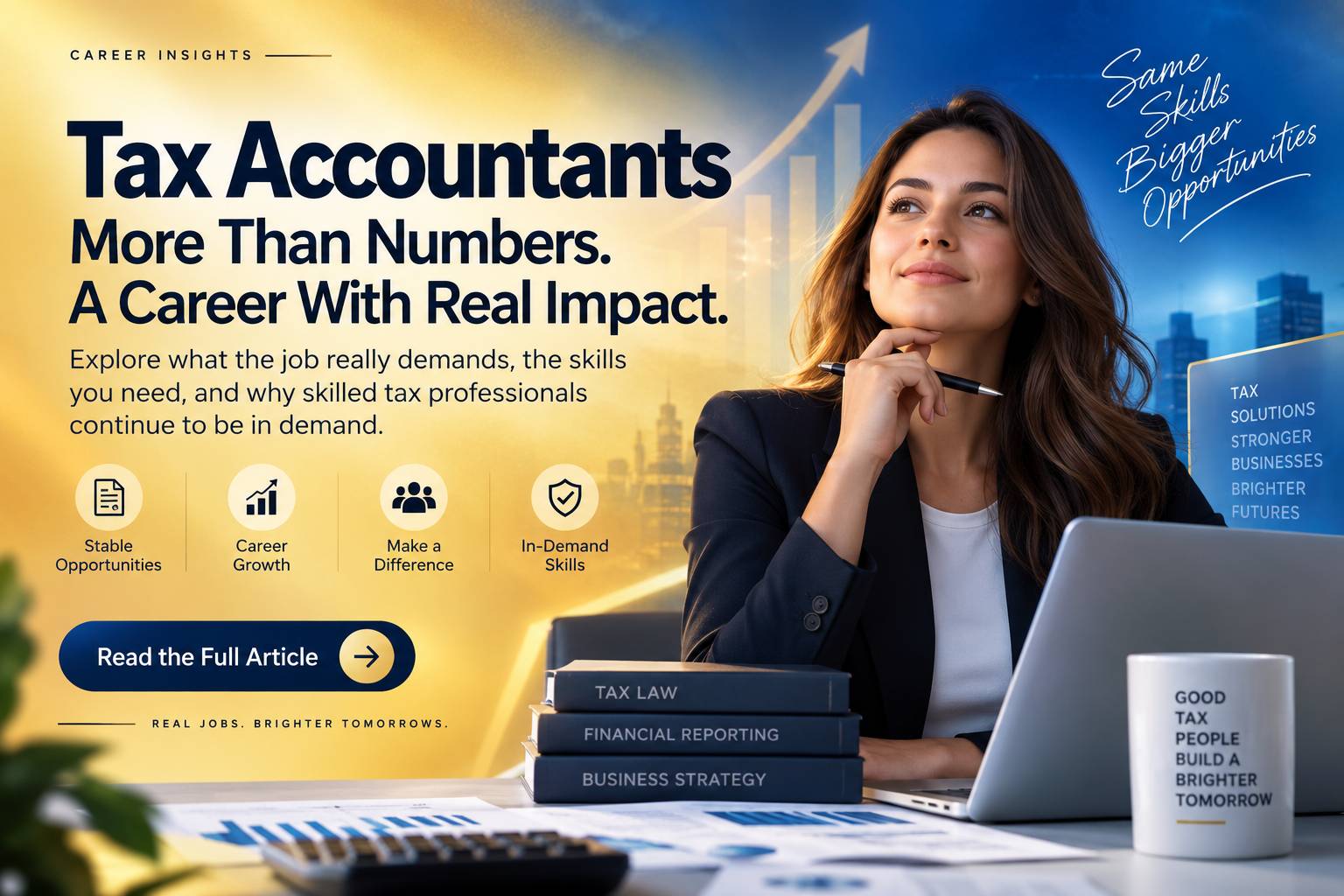
Tax Accountants work in a field where small mistakes can carry real consequences. A missed figure, an incorrect classification, or incomplete documentation can create problems long after a return has been filed. That’s why businesses and individuals depend on professionals who can work through financial details carefully and make decisions they can stand behind.
The job has also become more demanding as tax regulations, financial transactions, and digital accounting systems continue to evolve. For people entering the accounting profession, tax work offers a clear path into a specialized field. The catch is that employers expect more than someone who can simply enter numbers and complete forms.
Tax Accountants Job Responsibilities and Career Demands
The day-to-day workload depends heavily on the employer. At a smaller accounting firm, a Tax Accountant might prepare returns in the morning, answer a client’s question after lunch, and spend the afternoon checking supporting records. Larger companies tend to divide the work among specialists, so the role may focus on a particular area of taxation or a defined group of business activities.
Typical responsibilities include reviewing financial records, preparing federal and state tax filings, reconciling account information, researching tax provisions, and checking for potential compliance problems. Communication is part of the job, too. Tax Accountants may need to explain an issue to a client, provide documentation to an auditor, or work with financial managers when figures don’t line up.
This is where attention to detail becomes more than a résumé phrase. A good accountant needs to notice when something looks unusual and know what to investigate. Employers value that judgment because catching an issue early is usually far easier than fixing it after a filing or reporting deadline has passed.
Filing seasons can make the workload particularly intense. Several deadlines may overlap, client requests can arrive at the same time, and the margin for careless work gets smaller. Experienced Tax Accountants learn how to organize their workload, verify important figures, and keep moving without allowing speed to undermine accuracy.
Tax Accountants Near Me and the Local Job Market
A search for Tax Accountants near me can reveal how different the local employment market can be. One area may have several public accounting firms hiring tax staff, while another may offer more opportunities inside corporate finance departments. The job title stays familiar, but the actual work can be quite different.
Local demand is also shaped by the businesses operating in the area. A major commercial market may generate openings involving corporate taxes, partnerships, payroll, or state and local taxation. Smaller communities can offer broader positions in which one accountant handles a wider range of client and compliance duties.
That distinction matters when choosing a position. The first available job isn’t necessarily the best career move. A role that exposes a new accountant to tax research, client communication, financial analysis, and compliance systems can provide a stronger foundation than one built almost entirely around repetitive preparation work.
Candidates searching for Tax Accountant near me should read job descriptions closely rather than relying on the title alone. Requirements such as CPA eligibility, experience with tax software, advanced Excel skills, public accounting exposure, or knowledge of specific tax regulations usually tell you a great deal about what the employer expects from the person hired.
Tax Accountants Skills, Technology, and Career Growth
Technology has changed the working environment for Tax Accountants. Cloud accounting platforms, electronic filing, automated reconciliation, tax preparation software, and data tools now handle many tasks that once required manual work. That saves time, but it also changes where professional value comes from.
A software system can flag an unusual transaction. It can’t always explain why that transaction occurred or whether it actually creates a tax issue. Someone still has to examine the underlying records, understand the circumstances, and decide what deserves further attention. Strong analytical skills therefore remain important even in highly automated tax departments.
Digital tax systems have changed the taxpayer side of the process as well. Tools such as My Tax Account reflect the growing use of online platforms for managing tax information and related services. Tax professionals who understand these systems can often communicate more effectively with clients and help resolve routine issues without relying on paper-based processes.
This shift has raised the bar for many employers. Technical tax knowledge remains essential, but candidates who can work comfortably with financial data, spreadsheets, accounting platforms, and tax software have an advantage. The ability to review automated results critically is just as important as knowing how to produce them.
The type of employer can shape that experience. A position such as Majeski Jahnke Tax Accountant in Minneapolis, MN represents the kind of opportunity found within a local accounting environment, where tax preparation, client service, and practical problem-solving may all form part of the role.
Corporate settings can look quite different. An opportunity such as Koch Companies Services Tax Accountant in Atlanta, GA demonstrates how tax accounting skills can be applied within a larger organization, where internal reporting, business operations, and established financial processes can influence the responsibilities attached to the position.
Career progression usually follows the level of responsibility a professional can handle. Someone starting in an entry-level tax role may move into senior tax accounting, tax management, corporate tax, public accounting, or a specialized area such as international or state and local taxation. Credentials can help, but practical experience remains a major part of that progression.
Years on the job aren’t enough by themselves. The more useful measure is what a Tax Accountant learns to handle along the way: more complicated returns, difficult client questions, unfamiliar transactions, tighter deadlines, and decisions where the correct answer isn’t immediately obvious.
FAQ Tax Accountants Career and Jobs
1. Are Tax Accountants still in demand as accounting technology becomes more automated?
Yes. Automation has taken over many repetitive accounting tasks, but Tax Accountants are still needed for tax research, compliance review, unusual transactions, financial analysis, and professional judgment. Software can process information quickly, yet employers still need people who can understand the results, identify potential problems, and determine what action should be taken.
2. What qualifications do employers commonly look for when hiring Tax Accountants?
Requirements depend on the position, but employers commonly look for an accounting or finance background, knowledge of tax rules, strong Excel skills, and experience with accounting or tax software. Some jobs require or prefer CPA credentials, while entry-level positions may focus more on education, analytical ability, accuracy, communication skills, and the candidate’s capacity to learn.
3. Is becoming a Tax Accountant a good career choice for someone starting in accounting?
Tax accounting can provide a solid starting point for someone interested in detailed financial work and regulatory analysis. The experience can lead to senior accounting positions, tax management, corporate tax departments, public accounting, or specialized tax practices. Progress depends on developing technical knowledge while taking on increasingly complex responsibilities.
Tax Accountants remain an important part of the financial workforce because tax work demands accuracy, judgment, and an understanding of constantly changing requirements. Technology will continue to reshape the routine side of the profession, but professionals who can interpret financial information, investigate problems, communicate clearly, and handle greater responsibility will continue to have meaningful opportunities in tax accounting.