Info Hot Job Find your dream job! Get for jobs, post your resume, compare salaries and find career advice and research.
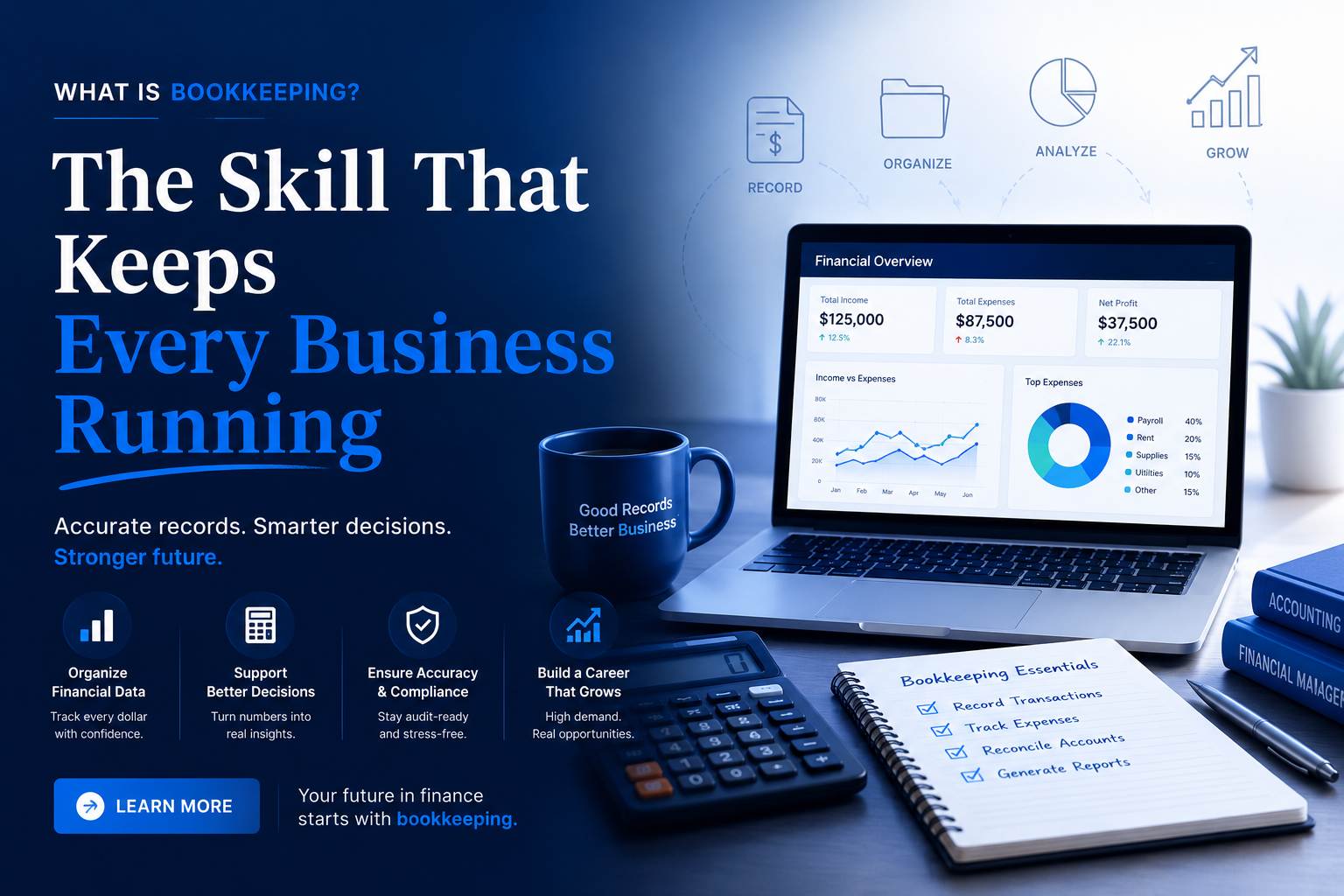
Bookkeeping is one of those skills that quietly powers every successful business. While customers notice products and services, accurate financial records keep operations running behind the scenes. Every invoice, payment, expense, and payroll entry contributes to a company’s financial health, making bookkeeping an essential business function rather than just routine paperwork.
As businesses continue to rely on accurate financial reporting, the demand for skilled bookkeepers remains steady across industries. Small businesses, large corporations, healthcare organizations, retailers, manufacturers, and nonprofit organizations all depend on professionals who can organize financial information with precision. Understanding What Is Bookkeeping is the first step toward exploring a career that combines stability, problem-solving, and long-term growth.
Understanding What Is Bookkeeping and Why It Matters
What Is Bookkeeping? Simply put, bookkeeping is the process of recording, organizing, and maintaining a company’s financial transactions. Every sale, purchase, payment, receipt, and expense must be documented correctly so business owners always know where their money is going.
Bookkeeping creates the financial foundation for accounting. Without complete and accurate records, accountants cannot prepare reliable financial statements, calculate taxes correctly, or analyze business performance. This relationship explains why employers consistently seek candidates who understand bookkeeping fundamentals.
Modern bookkeeping extends beyond writing numbers into ledgers. Today’s professionals often use cloud-based accounting software, automate recurring transactions, reconcile bank accounts, monitor accounts payable and receivable, and generate reports that help managers make informed business decisions. Although technology has simplified many tasks, attention to detail remains the defining characteristic of an excellent bookkeeper.
What Is Bookkeeping in Today’s Job Market?
The job market has changed significantly over the last decade, but bookkeeping continues to offer dependable employment opportunities. Digital transformation has not eliminated bookkeeping jobs. Instead, it has changed the skills employers expect from candidates.
Companies increasingly value professionals who combine financial knowledge with software proficiency. Experience using platforms like QuickBooks, Xero, FreshBooks, or Sage often improves employability because businesses want people who can adapt quickly to modern accounting systems.
Remote work has also expanded opportunities. Many organizations now hire virtual bookkeepers who maintain financial records from home while collaborating through cloud-based platforms. This flexibility allows professionals to work with companies across different states or even internationally without relocating.
Strong communication skills have become another valuable asset. Bookkeepers regularly coordinate with business owners, accountants, vendors, payroll departments, and tax professionals. The ability to explain financial information clearly often distinguishes exceptional candidates from average applicants.
If you’re considering this profession, learning about bookkeeping, accounting, and auditing clerk careers provides valuable insight into daily responsibilities and long-term career opportunities.
Skills Employers Expect from Bookkeepers
Successful bookkeeping requires much more than mathematical ability. Employers typically prioritize organization, consistency, accuracy, and integrity above everything else. A single recording error can affect financial reports, tax filings, or budgeting decisions, making precision a critical workplace skill.
Technology literacy is equally important. Most bookkeeping tasks are performed using accounting software rather than paper ledgers. Candidates who understand spreadsheets, financial databases, online banking systems, and digital document management often have a competitive advantage during recruitment.
Problem-solving also plays a significant role. Transactions occasionally fail to match bank statements, invoices may contain discrepancies, or missing documentation may require investigation. Skilled bookkeepers know how to identify issues quickly while maintaining accurate financial records.
Professional ethics should never be overlooked. Because bookkeepers handle sensitive financial information, employers expect complete confidentiality, honesty, and accountability. Trust is often the most valuable qualification a bookkeeper can demonstrate.
Professionals interested in expanding these technical skills may benefit from understanding double-entry bookkeeping, which remains the standard system used in modern financial management.
Career Growth After Learning What Is Bookkeeping
Many people assume bookkeeping is a career with limited advancement, but the reality is far different. Bookkeeping frequently serves as an entry point into broader financial careers. Experience gained in maintaining financial records builds practical knowledge that supports advancement into accounting, payroll management, financial analysis, auditing, or office management.
Some professionals continue their education and earn certifications that increase earning potential. Others specialize in industries such as healthcare, construction, manufacturing, or nonprofit organizations where financial regulations require additional expertise.
Entrepreneurial opportunities are also growing. Freelance bookkeepers and independent bookkeeping consultants increasingly serve multiple clients through cloud accounting platforms. This business model allows experienced professionals to control their schedules while expanding their client base over time.
Students preparing for finance-related careers often strengthen their knowledge through academic programs such as Rutgers student accounting resources, where bookkeeping concepts support broader accounting education.
For job seekers exploring real-world opportunities, reviewing positions like the Boston outdoor recreation bookkeeping accounting clerk role offers practical insight into employer expectations.
Why Businesses Will Always Need Bookkeepers
Artificial intelligence and automation continue to transform finance departments, but they have not replaced human judgment. Software can categorize transactions, import banking data, and generate reports, yet someone must review exceptions, resolve discrepancies, verify accuracy, and ensure compliance with financial standards.
Business owners also value professional guidance. When unusual financial situations occur, experienced bookkeepers help maintain organized records that support informed decision-making. Their expertise reduces costly mistakes while improving operational efficiency.
Economic uncertainty further reinforces the importance of accurate bookkeeping. Companies facing changing markets need reliable financial information to manage cash flow, control expenses, and evaluate profitability. Well-maintained books provide the clarity leaders need to make confident decisions during both growth and challenging periods.
Those considering bookkeeping as a profession may also benefit from exploring bookkeeping, accounting, and auditing clerk jobs, which illustrate how these responsibilities translate into rewarding career paths.
Professionals looking to deepen their knowledge with practical resources can also explore this highly recommended guide: Bookkeeping Essentials.
FAQ Bookkeeping Career
1. Is bookkeeping still a good career choice in 2026?
Yes. Bookkeeping continues to offer stable employment because every organization requires accurate financial records regardless of industry. While automation handles repetitive tasks, employers still depend on professionals to review transactions, resolve inconsistencies, maintain compliance, and communicate financial information clearly. Cloud accounting has also created more remote and freelance opportunities, allowing experienced bookkeepers to work with clients across multiple locations while maintaining flexible schedules.
2. Do you need a college degree to start bookkeeping?
Not necessarily. Many employers value practical bookkeeping skills, accounting software experience, and strong organizational abilities as much as formal education. A degree in accounting or finance can certainly improve career prospects, but certifications, vocational training, and hands-on experience often provide an effective pathway into the profession. As professionals gain experience, they frequently move into higher-paying accounting, payroll, or financial management roles through continuous learning and demonstrated performance.
3. What’s the difference between bookkeeping and accounting?
Bookkeeping focuses on recording and organizing daily financial transactions, ensuring every payment, expense, invoice, and receipt is accurately documented. Accounting builds upon those records by analyzing financial data, preparing reports, developing budgets, completing tax filings, and supporting strategic business decisions. Both functions work together, but bookkeeping provides the reliable foundation that allows accountants to produce meaningful financial insights and help organizations plan for future growth.
Apply Bookkeeping JobsUnderstanding What Is Bookkeeping reveals far more than a simple administrative task. It is a profession built on accuracy, responsibility, and financial awareness, supporting every successful organization. As businesses continue embracing digital accounting systems, the role of skilled bookkeepers remains essential because technology still depends on knowledgeable professionals who can verify information, solve problems, and maintain financial integrity.
For individuals seeking a practical career with consistent demand, opportunities for advancement, and transferable skills, bookkeeping offers a strong starting point. Mastering the fundamentals today can open doors to accounting, finance, auditing, and business leadership tomorrow, making bookkeeping one of the most reliable career paths in the modern job market.