Info Hot Job Find your dream job! Get for jobs, post your resume, compare salaries and find career advice and research.
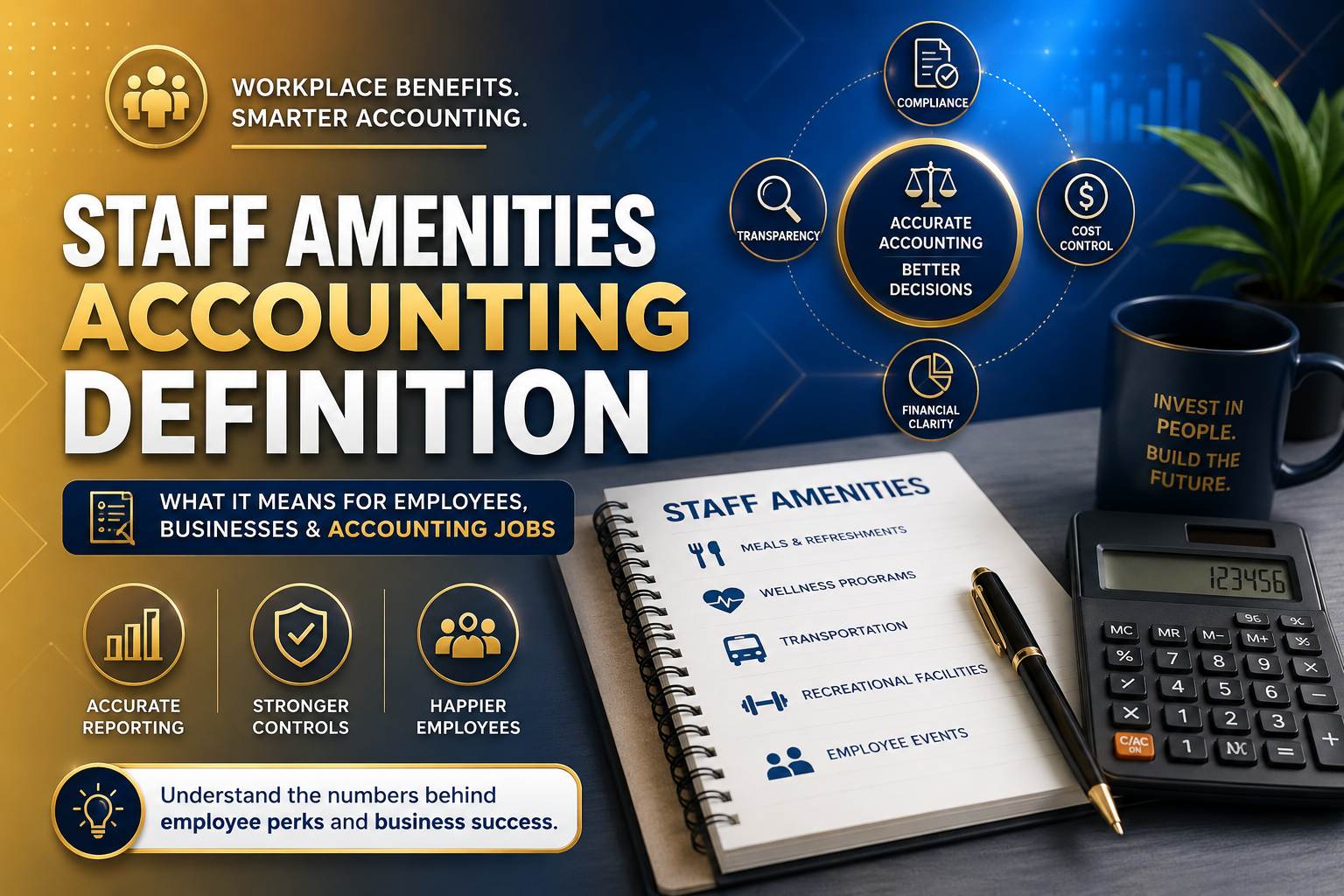
Staff amenities can look like small workplace perks, but they can create surprisingly important accounting questions. Free meals, coffee stations, employee lounges, parking facilities, wellness programs, and recreational areas all cost money, and businesses need to determine how those costs should be recorded, controlled, and reported.
The Staff Amenities Accounting Definition generally refers to the accounting treatment of expenses incurred by an employer to provide facilities, services, or benefits that improve employees’ workplace experience. The key issue isn’t simply whether an expense benefits staff. Accounting teams must determine what the expense represents, whether it is business-related, how it should be classified, and whether tax or reporting rules apply.
For employers, accurate treatment protects financial reporting quality. For accounting professionals, understanding these expenses demonstrates something more valuable than basic bookkeeping skills: the ability to connect everyday business spending with accounting policy and financial control.
Staff Amenities Accounting Definition and Expense Classification
The Staff Amenities Accounting Definition becomes clearer when amenities are viewed through the lens of business expenditure. A company may provide refreshments, staff dining facilities, transportation assistance, parking, childcare support, fitness facilities, or employee social activities. Although these expenses may appear unrelated to core operations, they can be legitimate operating costs when they support the workforce and business environment.
The accounting treatment depends heavily on the nature of the expense. A recurring coffee supply may be recorded differently from the purchase of furniture for an employee lounge. A company-sponsored event may also require different treatment from an employee transportation arrangement. The accounting department therefore needs sufficient documentation to identify what was purchased, who benefited, why it was purchased, and how frequently the expense occurs.
This is where professional judgment matters. Simply placing every employee-related purchase into a generic “staff amenities” account can make financial reports less useful. A well-designed chart of accounts should provide enough detail for management to understand spending without creating unnecessary administrative complexity.
Businesses also need to distinguish between operating expenses and assets. Equipment or furniture used for staff facilities may potentially require capitalization depending on the applicable accounting framework and the company’s capitalization policy. Consumable items, services, and routine maintenance generally follow a different accounting path.
The strongest accounting process starts with a clear internal policy. Employees submitting expenses should know which purchases qualify, what documentation is required, and which costs require management approval. That structure reduces inconsistent coding and makes month-end reconciliation considerably easier.
Staff Amenities Expenses and Accounting Jobs
Understanding staff amenities expenses can become particularly relevant for people working in accounting jobs. Staff accountants, senior accountants, payroll specialists, and financial controllers often deal with employee-related expenses even when those costs aren’t their primary responsibility.
A staff accountant may be responsible for reviewing invoices, assigning general ledger codes, reconciling expense accounts, preparing journal entries, and supporting month-end close procedures. An incorrectly classified staff amenity expense can therefore become more than a minor bookkeeping error. If similar transactions are repeatedly coded incorrectly, management reports can provide a distorted view of operating costs.
A Staff Accountant II job description typically reflects responsibilities that require accuracy, reconciliation skills, financial reporting knowledge, and attention to transaction-level detail. Those same skills are useful when analyzing employee-related expenses.
Senior-level accounting positions require even greater judgment. A Senior Staff Accountant role can involve reviewing accounting records, supporting financial statements, analyzing variances, and maintaining proper internal controls. Staff amenities may represent only a small portion of total expenses, but the accounting principle remains the same: transactions should be classified consistently and supported by reliable documentation.
The issue becomes more practical when a company has multiple locations or departments. A $500 employee event might be straightforward in a small organization, while a national employer could have thousands of similar transactions across different cost centers. Accounting professionals must maintain consistency while still allowing management to track spending by department, location, or business function.
For job seekers, this is a useful reminder that accounting careers aren’t limited to entering numbers. Employers increasingly expect accountants to understand why transactions are recorded a certain way and how those decisions affect reporting, compliance, budgeting, and management decisions.
Professionals exploring opportunities can also review Senior Staff Accountant Jobs in Atlanta, GA with competitive salary, hybrid work, and career growth to see how broader accounting responsibilities are reflected in current roles.
Another relevant example is the Orbis Education Staff Accountant position in Carmel, IN, where accounting responsibilities can provide insight into the level of accuracy and financial discipline expected from modern accounting professionals.
For experienced candidates, opportunities such as the Beacon Hill Staffing Senior Staff Accountant position in Lewisville, TX illustrate how senior accounting work extends beyond routine transaction processing into analysis, reporting, and financial control.
Staff Amenities Accounting Treatment and Workplace Controls
The accounting treatment of staff amenities should be supported by practical internal controls. A company needs to establish clear approval thresholds, appropriate expense categories, documentation requirements, and procedures for reviewing unusual transactions.
The most common weakness isn’t necessarily fraud. It’s inconsistency. One department may classify employee meals as staff welfare expenses while another records similar transactions as entertainment or general administrative costs. Over time, that inconsistency can make departmental comparisons unreliable and complicate budgeting.
Accounting teams should therefore establish consistent definitions and coding rules. Expense descriptions should be specific enough to explain the transaction, while supporting documents should make the business purpose clear. Monthly reviews can identify unusual increases in staff amenities spending and help management determine whether those changes reflect genuine business activity or coding problems.
Tax treatment also deserves separate consideration. An expense can be acceptable under an organization’s accounting policy while receiving different treatment for tax purposes. Local tax regulations, employee benefit rules, and the nature of the amenity can influence the final treatment. Because these rules vary by jurisdiction and can change, businesses should rely on the applicable accounting and tax requirements rather than assuming that every employee-related cost receives identical treatment.
For accounting professionals, this distinction is important. Strong financial reporting requires more than knowing where to place an expense in the general ledger. It requires understanding the underlying transaction, applying the relevant accounting policy, documenting the judgment, and recognizing when specialist tax advice may be necessary.
FAQ Staff Amenities Accounting Definition
- What is the Staff Amenities Accounting Definition?
The Staff Amenities Accounting Definition describes how an organization identifies, classifies, records, and controls expenses associated with employee facilities, services, and workplace benefits. Examples can include refreshments, employee events, recreational facilities, parking, transportation assistance, and other workplace amenities. The exact accounting treatment depends on the nature of the transaction, company policy, applicable accounting standards, and relevant tax requirements. - Are staff amenities considered an operating expense?
Staff amenities can generally be treated as operating expenses when they represent ordinary costs incurred to support the organization’s workforce and business operations, but the classification depends on the specific transaction. Routine supplies and services may be expensed, while qualifying equipment or other long-term purchases may require different treatment under the company’s capitalization policy and applicable accounting framework. - Why should accountants understand staff amenities expenses?
Accountants need to understand staff amenities expenses because accurate classification affects financial reporting, budgeting, cost analysis, and internal controls. Even relatively small transactions can become significant when repeated across departments or locations. Strong accounting professionals can identify the business purpose, apply consistent coding, maintain supporting documentation, and recognize when tax or reporting considerations require additional review.
The Staff Amenities Accounting Definition goes beyond labeling employee perks as ordinary workplace expenses. Proper accounting requires organizations to understand the nature and purpose of each transaction, apply consistent classification rules, maintain adequate documentation, and consider relevant accounting and tax requirements. For accounting professionals, familiarity with these details reinforces an important career advantage: the ability to turn everyday financial transactions into accurate, controlled, and useful business information.