Info Hot Job Find your dream job! Get for jobs, post your resume, compare salaries and find career advice and research.
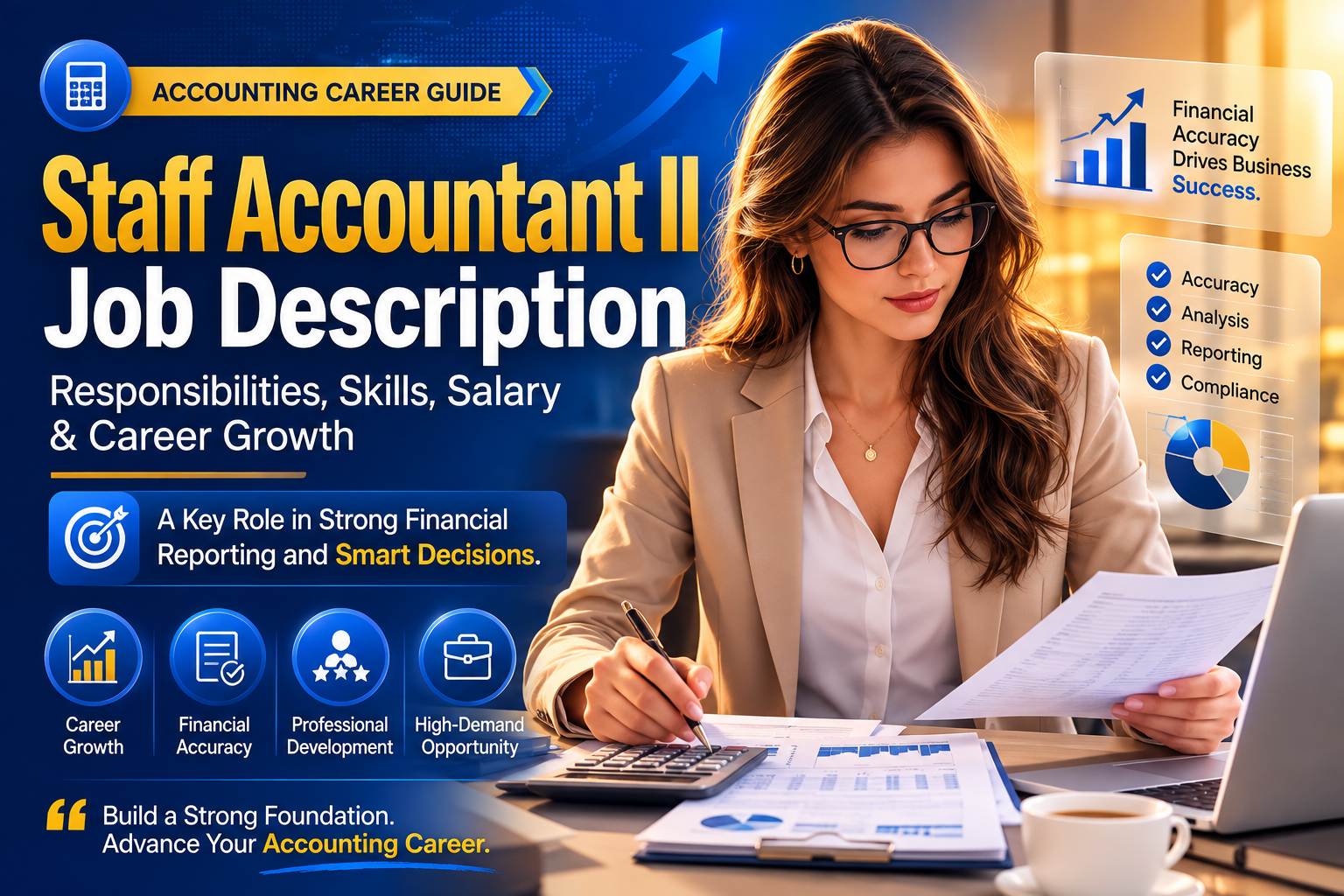
A Staff Accountant II role sits at an important point in an accounting career. It’s no longer an entry-level position where someone simply follows established procedures, but it also isn’t typically a senior leadership role. Employers expect a Staff Accountant II to work with greater independence, understand how financial transactions affect the general ledger, and catch problems before they become expensive reporting issues.
The difference matters because accounting departments rely on accuracy, consistency, and deadlines. A strong Staff Accountant II doesn’t just enter numbers into a system. This professional helps maintain reliable financial records, supports month-end close, investigates discrepancies, and gives management confidence that the numbers tell the right story.
Staff Accountant II Job Description and Core Responsibilities
The typical Staff Accountant II job description includes a broader range of accounting responsibilities than those assigned to a Staff Accountant I. The position commonly supports general ledger accounting, account reconciliations, journal entries, accruals, financial reporting, accounts payable or receivable activities, and month-end closing procedures.
A Staff Accountant II may prepare recurring and adjusting journal entries, reconcile bank and balance sheet accounts, research unusual transactions, and ensure accounting records comply with company policies and applicable accounting standards. Accuracy is critical because even a small posting error can flow into financial statements and create additional work during the close process.
Month-end close is often one of the most demanding parts of the job. The accountant may need to complete reconciliations, verify supporting documentation, record accruals, review account balances, and resolve discrepancies within a limited timeframe. When several departments depend on the same financial data, the ability to prioritize work becomes just as important as technical accounting knowledge.
The role may also involve preparing schedules and reports for supervisors, finance managers, auditors, or other stakeholders. Depending on the employer, Staff Accountant II professionals can participate in internal audits, external audit requests, budgeting activities, tax support, fixed-asset accounting, and process improvement initiatives.
Staff Accountant II Skills and Qualifications
A successful Staff Accountant II needs solid accounting fundamentals and enough practical experience to work without constant supervision. Most employers look for a bachelor’s degree in accounting, finance, business, or a related field, although equivalent professional experience may sometimes be accepted.
Experience with general ledger systems and accounting software is highly valuable. Employers may use platforms such as Oracle, SAP, NetSuite, Microsoft Dynamics, QuickBooks, or specialized enterprise accounting systems. Strong Excel skills are also frequently expected, particularly when the position requires reconciliations, financial analysis, reporting, or large data sets.
Technical ability alone, however, doesn’t make someone effective in this role. A Staff Accountant II must be comfortable questioning unusual transactions, tracing discrepancies back to their source, and explaining financial information clearly. Attention to detail is essential, but so is judgment. An accountant who notices an error but doesn’t investigate why it happened may solve today’s problem while leaving tomorrow’s problem untouched.
Communication skills also carry more weight at this level. Staff Accountant II professionals often interact with accounts payable, accounts receivable, payroll, purchasing, operations, and finance teams. They need to ask precise questions, document findings, and communicate issues without creating unnecessary confusion.
Employers may also value knowledge of GAAP, internal controls, financial statement preparation, and audit procedures. Professional certifications such as the CPA can strengthen career prospects, although certification isn’t normally required for every Staff Accountant II position.
Staff Accountant II Salary, Career Growth, and Job Outlook
Compensation for a Staff Accountant II varies substantially based on location, industry, company size, experience, education, and the complexity of the accounting environment. A position in a major metropolitan market or specialized industry may offer significantly different compensation from a similar role at a smaller organization.
Career progression is one of the strongest reasons professionals pursue this position. Staff Accountant II can provide a practical bridge toward roles such as Senior Staff Accountant, Senior Accountant, Accounting Supervisor, Accounting Manager, or Financial Analyst. The path depends heavily on performance and whether the employee develops skills beyond routine transaction processing.
For professionals who want to move upward, simply completing assigned accounting tasks isn’t enough. The better strategy is to become the person who can solve problems, improve reconciliation processes, strengthen controls, and take ownership of complicated accounting areas. That distinction can make a major difference when management evaluates candidates for promotion.
The job can also provide exposure to different areas of finance. Someone working with reconciliations and general ledger activities may eventually move into financial reporting, FP&A, audit, tax, controllership, or specialized accounting functions. That flexibility makes the Staff Accountant II position valuable for professionals who haven’t yet chosen a long-term accounting specialization.
For employers, the role presents a different challenge. Hiring a candidate who has the right accounting degree but lacks practical judgment can create bottlenecks during close and increase the workload for senior accounting staff. A good hiring decision should therefore consider demonstrated problem-solving ability, systems experience, communication, and the candidate’s ability to work independently—not just years of experience on a resume.
Professionals interested in advancing into higher-level accounting positions can also explore Senior Staff Accountant opportunities to understand how responsibilities expand at the next career stage.
Job seekers looking for opportunities in a specific market may also find Senior Staff Accountant jobs in Atlanta, GA, particularly when comparing compensation, workplace flexibility, and career growth potential.
Another useful option is the Staff Accountant opportunity at Orbis Education in Carmel, Indiana, which illustrates how accounting roles can differ depending on the organization’s industry and operating structure.
Professionals exploring staffing and recruiting opportunities can review the Senior Staff Accountant position in Lewisville, Texas for another example of how employers define responsibilities and qualifications.
For candidates specifically interested in Staff Accountant II roles, the Staff Accountant II opportunity with Ingersoll Rand in North Carolina provides a relevant example of the position in a large corporate environment.
FAQ Staff Accountant II Job Description
- What does a Staff Accountant II do on a typical day?
Typical responsibilities can include preparing journal entries, completing account reconciliations, reviewing general ledger activity, supporting month-end close, researching discrepancies, preparing financial schedules, and responding to audit or management requests. The exact workload depends on the employer, but the role generally requires more independent judgment and problem-solving than an entry-level accounting position.
- What qualifications are usually required for a Staff Accountant II position?
Most Staff Accountant II positions seek a bachelor’s degree in accounting, finance, or a related discipline along with practical accounting experience. Employers commonly value knowledge of GAAP, general ledger systems, reconciliations, financial reporting, and Excel. Experience with ERP platforms, month-end close, audits, and internal controls can strengthen a candidate’s profile, while CPA certification may be advantageous for long-term advancement.
- Is Staff Accountant II a good career step toward becoming a Senior Accountant?
Yes. Staff Accountant II is often a strong progression toward Senior Accountant because it provides greater exposure to reconciliations, financial reporting, month-end close, complex journal entries, internal controls, and accounting analysis. Professionals who consistently demonstrate accuracy, independence, problem-solving ability, and ownership of difficult accounting tasks are generally better positioned for advancement into senior-level responsibilities.
A Staff Accountant II position offers more than another accounting job title—it represents a meaningful stage of professional development where technical accuracy must be matched by judgment, independence, and accountability. Professionals who build strong general ledger knowledge, improve their analytical skills, understand financial reporting, and take ownership of complex accounting problems can use the role as a solid foundation for advancing toward senior accounting and management positions.