Info Hot Job Find your dream job! Get for jobs, post your resume, compare salaries and find career advice and research.
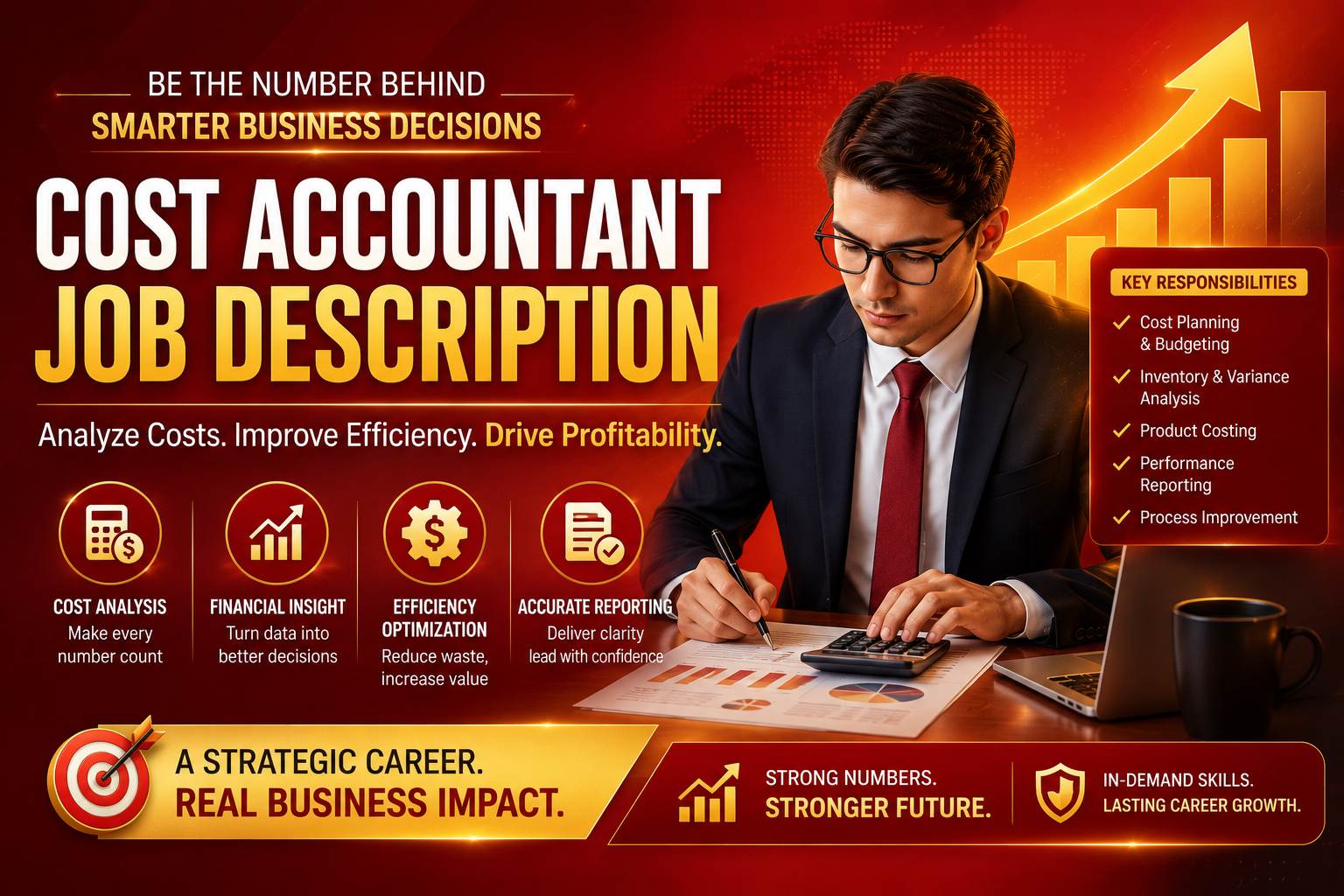
Every successful business depends on accurate financial decisions, and those decisions often begin with reliable cost analysis. That’s where a Cost Accountant Job Description becomes more than just a hiring document. It defines a role responsible for controlling expenses, improving profitability, and helping management understand exactly where money is earned—or lost.
As companies face rising production costs, supply chain challenges, and tighter profit margins, cost accountants have become valuable strategic partners rather than back-office number crunchers. Manufacturers, healthcare providers, logistics companies, retailers, and technology firms all rely on professionals who can transform financial data into practical business decisions. For job seekers, this creates a career path with strong demand, competitive salaries, and long-term advancement opportunities.
Cost Accountant Job Description Responsibilities and Daily Duties
A typical Cost Accountant Job Description centers on analyzing production costs, monitoring operational expenses, and ensuring financial accuracy across the organization. Unlike general accountants, cost accountants focus on identifying where resources are being used efficiently and where unnecessary spending affects profitability.
Daily responsibilities often include preparing cost reports, evaluating manufacturing expenses, calculating product costs, reviewing inventory valuations, analyzing labor expenses, and comparing budget forecasts against actual financial performance. Cost accountants also work closely with production managers, procurement teams, and senior executives to identify opportunities for reducing expenses without sacrificing quality.
Another important responsibility involves maintaining accurate financial records while ensuring compliance with accounting standards and internal company policies. During month-end and year-end closing processes, cost accountants frequently reconcile inventory accounts, prepare variance analyses, and explain financial trends to leadership teams.
The role extends beyond reporting numbers. Employers increasingly expect cost accountants to recommend practical improvements that increase operational efficiency and strengthen long-term profitability.
Professionals exploring broader accounting career opportunities may also benefit from reviewing various Jobs For Accounting Majors, which demonstrate how accounting skills transfer across multiple industries and financial specialties.
Skills Employers Expect in a Cost Accountant Career
Technical knowledge remains essential, but employers now prioritize candidates who combine financial expertise with strong analytical thinking and business awareness. An effective cost accountant understands accounting principles while also recognizing how financial decisions affect production, purchasing, pricing, and overall company performance.
Advanced Excel skills continue to be one of the most requested qualifications. Familiarity with ERP systems such as SAP, Oracle, Microsoft Dynamics, or NetSuite also provides a significant competitive advantage. Many organizations additionally value experience with Power BI, Tableau, and financial reporting software because modern accounting increasingly depends on data visualization and business intelligence.
Communication plays a surprisingly important role. Cost accountants frequently present financial findings to department managers who may not have accounting backgrounds. Explaining complex cost variances in simple language helps executives make informed operational decisions.
Problem-solving abilities also distinguish top candidates. Rather than simply identifying higher expenses, employers want professionals who investigate root causes and recommend practical solutions that improve profitability over time.
For those interested in analytical finance roles, the Financial Accounting Analyst position at The Walt Disney Studios illustrates how accounting expertise supports strategic financial planning within globally recognized organizations.
Salary Outlook and Career Advancement for Cost Accountants
A Cost Accountant Job Description often represents the beginning of a career with significant long-term earning potential. Entry-level professionals generally support senior accountants while developing practical experience in budgeting, inventory accounting, and financial analysis. As expertise grows, career progression becomes increasingly attractive.
Experienced cost accountants commonly advance into positions such as Senior Cost Accountant, Cost Accounting Manager, Finance Manager, Controller, Operations Finance Manager, or Chief Financial Officer. Professional certifications including Certified Public Accountant (CPA) or Certified Management Accountant (CMA) can further increase credibility and open leadership opportunities.
Industries with complex manufacturing processes frequently offer particularly competitive compensation because accurate cost management directly influences profitability. Companies producing consumer goods, pharmaceuticals, automotive components, aerospace equipment, food products, and industrial machinery often invest heavily in experienced cost accounting professionals.
Economic uncertainty also reinforces demand for cost accountants. Organizations continuously seek professionals capable of controlling expenses, maximizing efficiency, and protecting profit margins regardless of changing market conditions.
Professionals beginning their accounting journey may find valuable experience through Bookkeeping, Accounting, and Auditing Clerk Jobs, which provide practical exposure to financial reporting and daily accounting operations.
Candidates looking to strengthen their qualifications can also benefit from earning an Accounting Clerk Certificate, helping build technical confidence before pursuing specialized accounting positions.
Management-oriented accounting professionals may also find career paths similar to the CMI Management Accounting Clerk opportunity in Kansas City, MO, where financial reporting supports broader operational decision-making.
Preparing for interviews, certification exams, or professional development becomes easier with this practical Accounting Career Guide, designed to strengthen accounting knowledge and workplace readiness.
FAQ Cost Accountant Career
- What qualifications are usually required for a Cost Accountant Job Description?
Most employers prefer candidates with a bachelor’s degree in accounting, finance, or a closely related field. Practical experience through internships, bookkeeping, financial analysis, or manufacturing accounting significantly improves hiring prospects. Many organizations also value proficiency with Excel, ERP software, inventory management systems, and professional certifications such as CPA or CMA because these qualifications demonstrate technical competence and commitment to long-term career development.
- Is a Cost Accountant Job Description limited to manufacturing companies?
Not at all. Manufacturing remains one of the largest employers of cost accountants, but healthcare organizations, logistics providers, construction companies, retail businesses, energy firms, technology companies, and government agencies also require professionals who analyze operational costs and improve financial efficiency. Any organization seeking stronger budget control and profitability can benefit from experienced cost accounting professionals.
- Can a cost accountant advance into senior financial leadership roles?
Yes. Cost accounting provides a strong foundation for leadership because professionals develop expertise in budgeting, forecasting, operational finance, profitability analysis, and strategic planning. With experience and additional certifications, many cost accountants progress into senior positions such as Finance Manager, Controller, Director of Finance, Vice President of Finance, or Chief Financial Officer. Their understanding of both accounting principles and business operations makes them valuable decision-makers at the executive level.
A well-defined Cost Accountant Job Description reflects a profession that combines financial accuracy with strategic business impact. Organizations increasingly depend on professionals who can analyze costs, improve efficiency, and support sustainable profitability through data-driven decisions. For individuals seeking a stable accounting career with strong advancement opportunities, cost accounting remains one of the most valuable and resilient paths in today’s competitive job market.