Info Hot Job Find your dream job! Get for jobs, post your resume, compare salaries and find career advice and research.
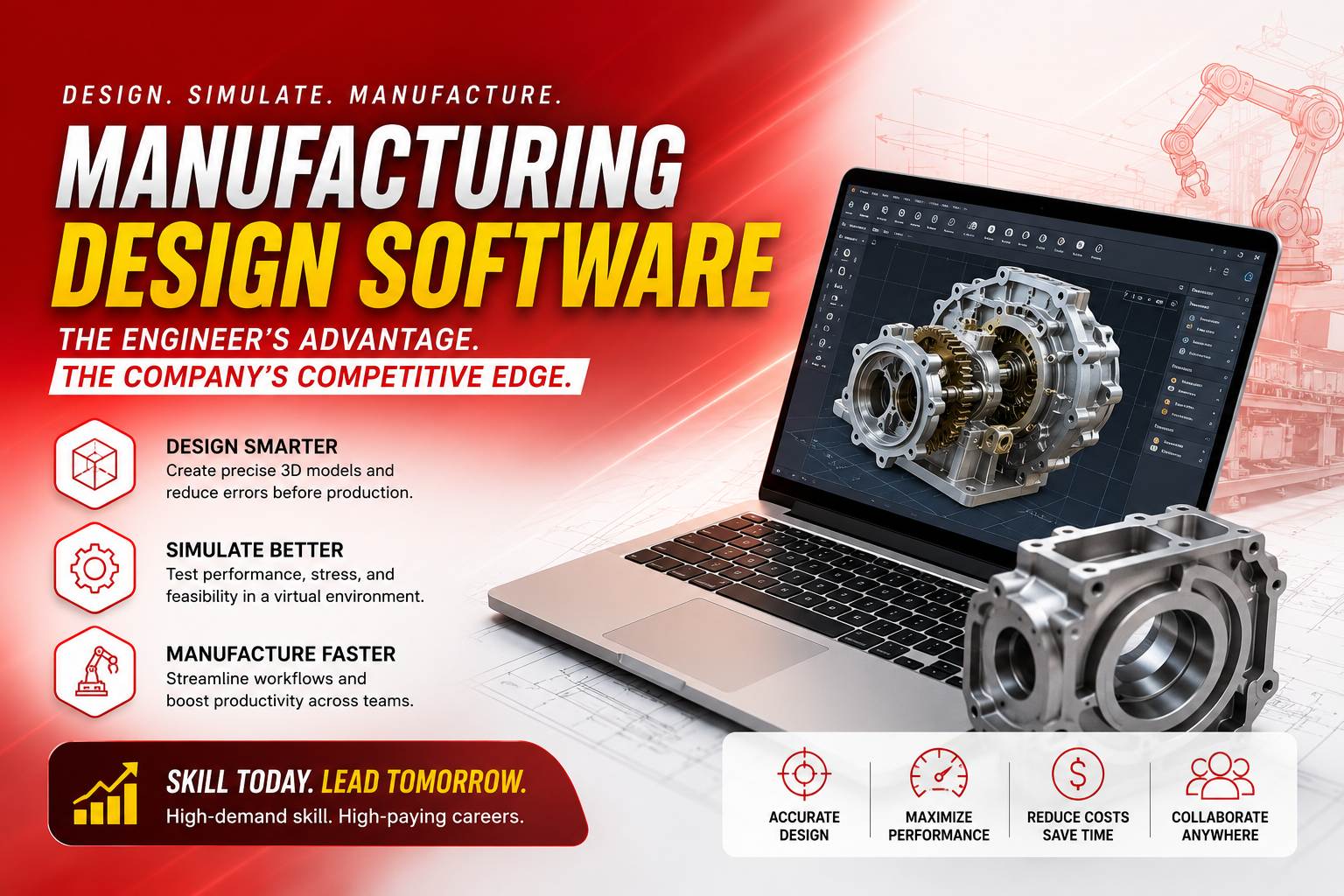
Manufacturing Design Software has become one of the most valuable technical skills in today’s industrial workforce. Companies are no longer searching only for engineers who understand production systems. They want professionals who can design products, optimize manufacturing processes, reduce costs, and collaborate across digital environments using advanced software platforms.
The manufacturing industry is changing faster than ever. Automation, digital twins, smart factories, and Industry 4.0 have transformed how products move from concept to production. As businesses invest in modern technologies, job seekers with Manufacturing Design Software expertise are finding themselves in stronger positions during recruitment. Employers recognize that software proficiency shortens project timelines, improves product quality, and minimizes costly design errors before production even begins.
Whether you’re a mechanical engineer, manufacturing engineer, industrial designer, CAD specialist, or a recent graduate preparing for your first engineering role, mastering Manufacturing Design Software can significantly improve your career prospects.
Manufacturing Design Software Skills Are Driving Engineering Careers
Modern manufacturing depends on digital workflows. Before a single component reaches the production floor, engineers spend countless hours creating 3D models, testing assemblies, simulating manufacturing conditions, and verifying production feasibility. Manufacturing Design Software makes every stage of this process faster and more accurate.
Companies value candidates who understand more than traditional drafting. They look for professionals capable of integrating design with manufacturing requirements. This includes creating production-ready models, identifying potential defects early, improving manufacturability, and collaborating with supply chain teams through digital platforms.
Hiring managers increasingly treat software competency as a competitive advantage rather than an optional qualification. Even entry-level positions often require familiarity with CAD, CAM, simulation software, or Product Lifecycle Management (PLM) systems. Applicants who already possess these skills usually require less onboarding, making them more attractive to employers.
The demand isn’t limited to large corporations. Small manufacturers, medical device companies, automotive suppliers, aerospace firms, electronics manufacturers, and consumer product businesses all rely on digital manufacturing tools to stay competitive.
Professionals interested in broader engineering opportunities may also explore roles like a Software Design Engineer, where technical design principles often overlap with manufacturing innovation.
Manufacturing Design Software Improves Productivity and Employability
One reason employers prioritize Manufacturing Design Software experience is measurable productivity. Digital design environments reduce repetitive work, automate calculations, generate documentation, and allow multiple departments to collaborate simultaneously.
Instead of relying on physical prototypes, engineers can simulate stress analysis, thermal performance, assembly movement, machining operations, and manufacturing constraints before production starts. This saves thousands of dollars in material costs while accelerating product development.
For job seekers, these capabilities translate directly into stronger resumes. Recruiters frequently search for candidates experienced with software that supports product development, manufacturing planning, CNC programming, and production optimization. Even when companies use different software vendors, understanding core digital manufacturing concepts makes adapting to new platforms much easier.
The increasing integration of artificial intelligence into engineering tools also creates opportunities for professionals who continue expanding their software knowledge. Organizations appreciate employees willing to learn emerging technologies rather than relying solely on traditional engineering methods.
Creative professionals looking to strengthen their digital design foundation may also benefit from exploring modern Online Graphic Design Software, especially when collaborating with product marketing or visualization teams.
Choosing Manufacturing Design Software for Long-Term Career Growth
Selecting the right Manufacturing Design Software depends on career goals, industry preferences, and the types of products a professional wants to develop. Mechanical engineering positions often prioritize solid modeling and assembly design, while manufacturing engineers may focus more heavily on production planning, machining strategies, and factory optimization.
Rather than attempting to master every available application, many successful engineers build expertise around one major platform while learning transferable principles. Understanding parametric modeling, geometric dimensioning, tolerance analysis, simulation workflows, and manufacturing documentation creates a foundation that remains valuable across different software ecosystems.
Certification programs can further strengthen professional credibility. While certifications alone won’t secure employment, they demonstrate commitment to continuous learning and help candidates stand out in competitive hiring processes.
Employers also appreciate practical experience. Personal projects, engineering portfolios, internships, collaborative university assignments, and freelance design work often carry significant weight during interviews because they demonstrate real-world problem-solving rather than theoretical knowledge alone.
Digital design skills extend beyond manufacturing. Professionals interested in specialized design fields can compare related technologies through resources covering Kitchen Design Software, illustrating how design workflows adapt across different industries.
Future Demand for Manufacturing Design Software Professionals
The future of manufacturing points toward greater digital integration rather than less. Smart factories continue adopting robotics, additive manufacturing, Industrial Internet of Things (IIoT), cloud collaboration, and predictive analytics. These technologies rely heavily on accurate digital models created through Manufacturing Design Software.
As experienced engineers retire, companies also face a growing skills gap. Younger professionals entering the workforce with strong software capabilities often advance more quickly because they contribute immediately to digital transformation initiatives.
Manufacturers increasingly seek multidisciplinary talent capable of bridging engineering, production, automation, quality assurance, and data analysis. Professionals who understand how digital design influences manufacturing efficiency become valuable contributors throughout an organization’s product lifecycle.
Remote collaboration has further increased the importance of digital engineering tools. Teams spread across different countries can now review designs, approve modifications, manage revisions, and coordinate manufacturing processes without requiring everyone to work from the same physical location.
Continuous learning remains essential. Software platforms evolve regularly, introducing automation features, AI-assisted modeling, cloud-based collaboration, and advanced simulation capabilities. Engineers who embrace ongoing education position themselves for leadership opportunities as manufacturing technologies continue advancing.
Professionals interested in expanding their broader digital design expertise can also discover valuable resources covering Web Design Software, which demonstrates how digital creativity supports multiple technology careers.
Those beginning their design journey may also find it worthwhile to compare various Free Graphic Design Software options before investing in premium professional tools.
FAQ Manufacturing Design Software
1. Is Manufacturing Design Software a good career skill for recent engineering graduates?
Absolutely. Manufacturing Design Software has become one of the most requested technical competencies across engineering job postings. Graduates who understand digital modeling, manufacturing simulation, CAD workflows, and production planning often gain an advantage during recruitment because employers spend less time providing basic software training. Combined with internships or portfolio projects, these skills can significantly improve employability while opening opportunities in automotive, aerospace, consumer products, electronics, medical devices, and industrial manufacturing companies.
2. What industries hire professionals with Manufacturing Design Software experience?
Manufacturing Design Software is used across a wide variety of industries rather than a single sector. Automotive manufacturers depend on it for vehicle development, aerospace companies use it for precision engineering, medical device firms rely on digital validation, while electronics manufacturers optimize compact product assemblies. Construction equipment, consumer goods, industrial machinery, renewable energy, and defense organizations also recruit professionals who understand digital manufacturing workflows because accurate design directly influences production efficiency and product quality.
3. Can learning Manufacturing Design Software increase salary potential?
In many cases, yes. Professionals who demonstrate strong Manufacturing Design Software expertise often qualify for higher-paying engineering positions because they contribute directly to product development efficiency and manufacturing optimization. Salary growth also depends on experience, certifications, industry specialization, project complexity, and leadership responsibilities. Engineers who continuously upgrade their software skills and remain current with Industry 4.0 technologies generally enjoy stronger long-term career progression than those relying only on traditional engineering methods.
Apply Manufacturing Design Software Jobs
Manufacturing Design Software is no longer just another technical skill on an engineering resume. It represents a practical capability that helps companies innovate faster, reduce production costs, improve product quality, and remain competitive in an increasingly digital manufacturing environment.
For job seekers, investing time in developing Manufacturing Design Software expertise creates more than technical knowledge. It builds confidence during interviews, expands career options across multiple industries, and positions professionals for future opportunities as manufacturing continues to embrace automation, digital engineering, and smart production systems. In a competitive employment market, the ability to transform ideas into manufacturable products through modern digital tools remains one of the strongest advantages an engineering professional can possess.