 Info Hot Job Find your dream job! Get for jobs, post your resume, compare salaries and find career advice and research.
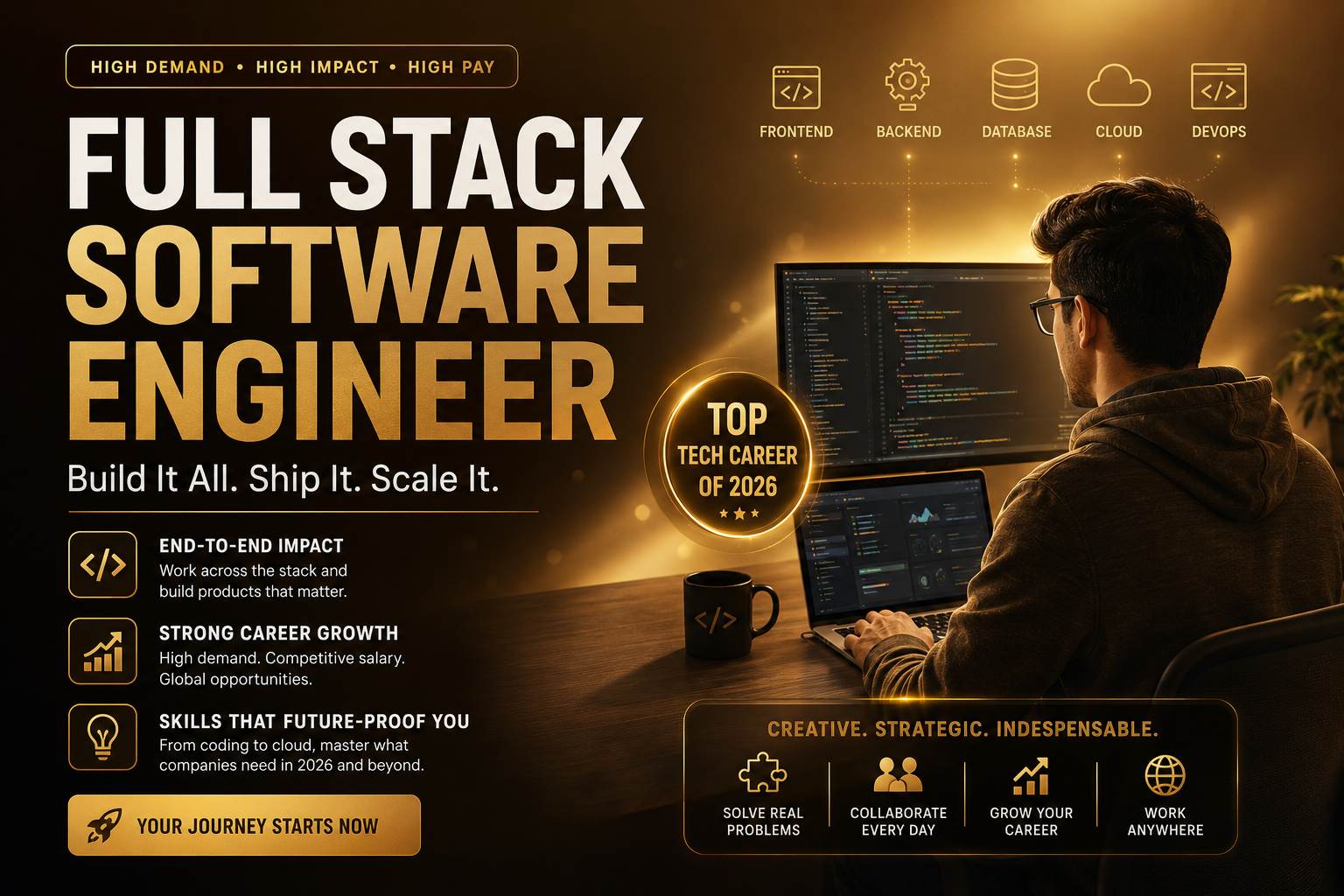
A Full Stack Software Engineer sits where the visible product meets the systems that make it work. Companies don’t hire this role simply to write more code; they hire engineers who can understand the entire application, make sound technical decisions, and turn a product requirement into something reliable, secure, and scalable.
That broad responsibility makes the role attractive, but it also makes the job market more demanding. Knowing a little about everything isn’t enough anymore. Employers increasingly want engineers who can move confidently between front-end interfaces, back-end services, databases, APIs, testing, deployment, and cloud infrastructure while still maintaining strong software engineering fundamentals.
Full Stack Software Engineer Skills Employers Want
The strongest candidates usually have depth in at least one area while remaining comfortable across the broader technology stack. On the front end, that can mean JavaScript or TypeScript combined with frameworks such as React, Next.js, or Vue. On the back end, employers may look for Node.js, Python, Java, C#, Go, or another production-ready language, depending on the company’s architecture.
Database knowledge matters just as much. A Full Stack Software Engineer may work with PostgreSQL, MySQL, MongoDB, Redis, or multiple database systems. Understanding data modeling, indexing, transactions, caching, authentication, and API design separates a production engineer from someone who can simply build a working demo.
Modern development also puts greater weight on cloud and deployment skills. Docker, CI/CD, cloud platforms, monitoring, version control, and infrastructure concepts can become part of the daily workload. The 2025 Stack Overflow Developer Survey found that Docker had one of the largest increases in reported technology usage, while PostgreSQL remained the most admired database technology.
AI has changed the workflow, too, but it hasn’t removed the need for engineering judgment. Stack Overflow reported that 84% of developers were using or planning to use AI tools in their development process, while 46% said they didn’t trust AI output accuracy. That distinction matters. A capable engineer uses AI to accelerate implementation, then reviews, tests, secures, and maintains the resulting code.
A job description that asks for an enormous list of technologies shouldn’t automatically intimidate candidates. The better question is whether the underlying skills transfer. Strong knowledge of HTTP, APIs, databases, asynchronous programming, testing, Git, security, and system design can remain valuable even when a company changes its framework.
If you’re starting your career, understanding the market early can help you target realistic opportunities. Our guide to entry-level software engineer salary provides useful context for candidates comparing early-career compensation.
Full Stack Software Engineer Job Responsibilities
The day-to-day work varies significantly by company, but the core responsibility is usually broader than writing front-end and back-end code separately. A Full Stack Software Engineer may design an application feature, create the user interface, build the API behind it, connect the database, write automated tests, deploy the change, and investigate problems after release.
That end-to-end ownership is precisely why employers value the position. A feature can look excellent in a browser and still fail because the API is slow, the database query doesn’t scale, authentication is weak, or deployment introduces an unexpected dependency. Full-stack engineers are expected to see those connections.
Collaboration is another major part of the job. Engineers commonly work with product managers, designers, QA professionals, DevOps teams, security specialists, and other developers. The ability to explain a technical tradeoff without turning every discussion into an argument is often just as useful as another programming language.
The market is also rewarding engineers who can adapt rather than memorize a fixed technology stack. Stack Overflow’s 2025 survey found that 69% of developers had spent time learning new coding techniques or programming languages during the previous year. That constant learning is becoming part of the profession, not an optional career upgrade.
Candidates researching career paths can also compare the broader software engineering education and career landscape before deciding which technical direction makes the most sense.
Internships remain another practical entry point. For students and recent graduates, a software engineer internship at Amazon can illustrate the type of technical experience large technology employers may expect from early-career candidates.
For experienced developers, the expectations change. A Senior Software Engineer role typically places greater emphasis on architecture, technical leadership, mentoring, system reliability, and high-impact decisions rather than simply completing assigned tickets.
Compensation also varies widely by location, experience, industry, company size, and specialization. Candidates should compare the complete package rather than focusing only on base salary. Equity, bonuses, remote-work policies, benefits, professional development, and promotion opportunities can materially change the value of an offer. For broader compensation context, see how much software engineers make.
FAQ Full Stack Software Engineer Career
- What does a Full Stack Software Engineer do?
- A Full Stack Software Engineer develops and maintains both the client-facing and server-side portions of software applications. The role can include building interfaces, designing APIs, managing databases, writing tests, fixing production issues, and supporting deployment. The exact responsibilities depend on the company, but the defining characteristic is the ability to contribute across multiple layers of an application rather than working exclusively on one technical area.*
- Is Full Stack Software Engineer a good career in 2026?
- Yes, it can be a strong career choice for engineers who enjoy solving problems across the software stack and are willing to keep learning. Modern teams increasingly value engineers who understand how front-end applications, APIs, databases, cloud services, security, and deployment work together. However, the market favors demonstrated engineering ability over simply collecting frameworks on a resume.*
- What skills should I learn to become a Full Stack Software Engineer?
- Start with strong programming fundamentals, Git, HTML, CSS, JavaScript or TypeScript, a modern front-end framework, back-end development, SQL, APIs, authentication, testing, and basic cloud deployment. Add Docker and CI/CD as your experience grows. AI-assisted development is also useful, but employers still need engineers who can understand the generated code, identify defects, and make reliable technical decisions.*
A Full Stack Software Engineer career offers strong opportunities for people who combine technical breadth with genuine engineering depth. The most valuable candidates aren’t necessarily those who know the most frameworks; they’re the ones who can understand a problem, choose practical technologies, build reliable software, and take responsibility for what happens after the code reaches production. As development tools continue to evolve, that ability to adapt, reason, and deliver will remain a powerful advantage in the job market.


