Info Hot Job Find your dream job! Get for jobs, post your resume, compare salaries and find career advice and research.
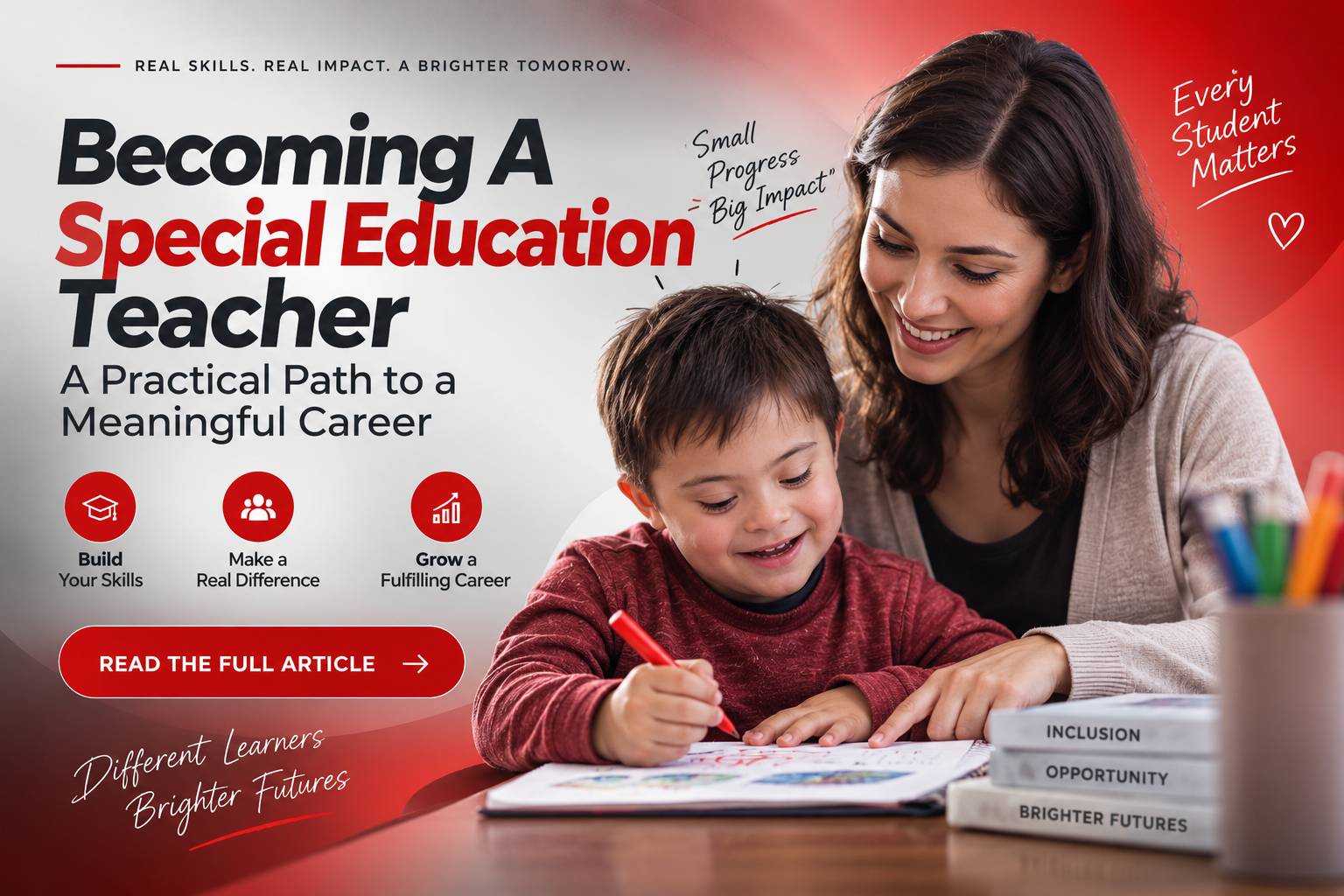
Choosing to become a teacher already comes with serious responsibility. Special education asks for even more because students don’t all learn, communicate, or respond to instruction in the same way. Becoming A Special Education Teacher can be a rewarding career choice, but good intentions aren’t enough to handle the demands of the job. Teachers need solid preparation, patience, flexibility, and the judgment to change course when a lesson isn’t working.
A special education classroom can include students with learning disabilities, autism, emotional or behavioral challenges, intellectual disabilities, physical disabilities, and other educational needs. The teacher’s role reaches well beyond delivering lessons. Academic development matters, but so do communication, independence, social participation, and the confidence to take on new challenges. Much of that work happens through cooperation with families, school staff, and other professionals.
What Does Becoming A Special Education Teacher Require?
For anyone considering Becoming A Special Education Teacher, the first practical question is where they intend to work. Public-school requirements are set largely at the state level, and most positions require a bachelor’s degree, an approved teacher preparation program, and a state license or certification. The details can differ by state, grade level, and credential, so checking the applicable education agency is a necessary step before committing to a particular route.
College preparation usually mixes coursework with supervised classroom experience. Subjects can include instructional methods, assessment, classroom management, child development, educational psychology, and special education law. Student teaching brings those subjects into a real classroom, where plans have to adapt to actual student behavior, different learning needs, and the pace of the school day.
For candidates who are still comparing teaching pathways, what education is needed to become a teacher provides useful background on the education and preparation commonly associated with teaching careers.
Earning a license doesn’t mark the end of professional preparation. Special education continues to evolve as schools adopt new teaching methods, accessibility features, assistive technologies, and approaches to student support. Staying current can therefore be part of the job rather than an occasional extra task.
Skills Needed for Becoming A Special Education Teacher
A degree may qualify someone for the profession, but classroom performance depends on what happens after the lesson begins. Special education teachers need to notice patterns, listen carefully, and figure out what may be preventing a student from making progress. Sometimes a small change in instructions or classroom setup can make a bigger difference than adding more work.
Patience is useful, particularly when progress takes time. Still, patience without problem-solving can leave a teacher stuck. When an assignment repeatedly causes difficulty, the answer might be simpler instructions, smaller steps, visual support, additional practice, or a completely different teaching approach. The ability to test a strategy, observe the result, and make a sensible adjustment is part of effective special education teaching.
Much of the work is collaborative, too. A teacher may communicate with parents, general education teachers, counselors, administrators, psychologists, speech-language professionals, and other specialists. Those conversations aren’t merely administrative. They can reveal how a student behaves in different settings and help everyone work toward consistent goals.
Then there’s the paperwork. Individualized education programs, progress records, assessments, accommodations, meetings, and lesson planning can take significant time. Organization becomes especially valuable when several responsibilities compete for attention. Digital resources can help with some of that workload, while also providing new ways to make lessons accessible.
Teachers searching for classroom materials and professional resources can find useful options through educational websites for teachers.
Becoming A Special Education Teacher and the Reality of the Job
The classroom is where the difference between expectations and reality becomes clear. A lesson can look perfectly reasonable on paper and still fall flat once students begin working. One student may need additional structure, another may need more time, and another may respond better to a completely different form of instruction.
That unpredictability is one reason special education teaching can be demanding. Teachers have to adjust without losing sight of educational goals. Behavioral challenges, communication barriers, learning differences, and uneven progress can all require a measured response. The work rewards consistency, but it leaves little room for a rigid teaching formula.
The workload extends beyond those classroom moments. Planning, documentation, assessments, meetings, family communication, and coordination with other professionals can occupy a substantial portion of a teacher’s schedule. School resources and staffing levels can also influence how manageable those duties are from one workplace to another.
Anyone entering the field should therefore look at the job from more than one angle. Wanting to make a difference is a strong reason to consider special education, but it shouldn’t replace practical questions about workload, qualifications, salary, and career development.
Pay is one of those questions. Special education teacher salaries vary according to state, school district, education, experience, and employment setting. Local data is more useful than a single national figure when evaluating a specific opportunity. A closer look at how much special education teachers make can help put the financial side of the career into perspective.
Another question concerns the kind of teacher a candidate wants to become. A teaching philosophy can influence decisions about inclusion, classroom management, instruction, student independence, and the role of the teacher. Exploring teachers’ philosophy of education can help future educators think through those principles before they face them in practice.
Student progress may also look different from what outsiders expect. A child completing an assignment independently, communicating a need more clearly, joining a group activity, or gaining confidence in a difficult skill can represent meaningful progress. These moments aren’t always dramatic, but they can show that an effective strategy is beginning to work.
That is where adaptability becomes more than a desirable personality trait. Special education teachers work with individual students rather than a single uniform learning profile. The ability to recognize what a student needs, adjust instruction, and keep working toward realistic goals is central to the profession.
FAQ: Becoming A Special Education Teacher
1. Do you need a special degree to become a special education teacher?
Most public-school special education teachers need a bachelor’s degree and state-approved preparation leading to the required teaching license or certification. The exact pathway varies by state and may depend on the grade level, credential, and student population. Some states also offer alternative certification routes for qualified candidates who meet specific requirements.
2. Is becoming a special education teacher difficult?
The pathway can be demanding because it combines academic preparation, supervised teaching experience, certification requirements, and continued professional development. The job itself can involve complex student needs, documentation, collaboration, and classroom challenges. Candidates who understand these responsibilities before entering the field can make more informed career decisions.
3. What makes a good special education teacher?
A strong special education teacher combines instructional knowledge with communication, adaptability, organization, patience, and sound professional judgment. Understanding individual learning needs is particularly important because students can respond very differently to the same strategy. Effective teachers continually observe progress, evaluate their methods, and make adjustments when students need a different approach.
Special education isn’t an easy career path, but it can be a meaningful one for people who are prepared for its responsibilities. Becoming A Special Education Teacher requires proper education, practical skills, patience, adaptability, and a realistic understanding of the workload. With the right preparation and a genuine commitment to helping students develop, this career can offer lasting professional value and the opportunity to make a measurable difference in students’ lives.