Info Hot Job Find your dream job! Get for jobs, post your resume, compare salaries and find career advice and research.
The demand for skilled maternity and women’s health professionals continues to grow, and the role of a Certified Nurse Midwife stands at the center of that movement. Hospitals, birth centers, and community clinics increasingly rely on midwives to provide personalized care that blends clinical expertise with compassionate support. Behind that trusted role lies a rigorous educational journey designed to build both scientific knowledge and hands-on clinical confidence.
Certified Nurse Midwife education is not simply about earning a credential. It’s about mastering the complex balance between medical science, patient advocacy, and holistic care. From foundational nursing knowledge to advanced graduate-level training, the educational pathway prepares professionals to manage pregnancies, assist childbirth, and support women’s health throughout the lifespan.

Certified Nurse Midwife Education Requirements and Academic Path
The journey toward becoming a Certified Nurse Midwife typically begins with a Bachelor of Science in Nursing (BSN). This undergraduate degree provides the essential clinical foundation in anatomy, pharmacology, patient care, and healthcare ethics. Students also gain real-world experience through hospital rotations where they learn to assess patients, assist physicians, and manage routine clinical procedures.
After obtaining a nursing degree and passing the NCLEX-RN to become a licensed registered nurse, aspiring midwives move into graduate-level education. Most Certified Nurse Midwives complete either a Master of Science in Nursing (MSN) or a Doctor of Nursing Practice (DNP) with a specialization in nurse-midwifery. These advanced programs dive deeper into maternal-fetal health, reproductive physiology, neonatal care, and advanced diagnostic skills.
Clinical training plays a central role during this stage. Students spend hundreds of hours working alongside experienced midwives and obstetricians. They learn how to monitor pregnancies, conduct prenatal exams, assist labor and delivery, and manage postpartum care. The goal is to develop professionals who can make sound clinical decisions while still delivering compassionate, patient-centered care.
For readers interested in understanding the broader profession, a deeper explanation of the role can be found in this guide about what a certified nurse midwife does in the United States.
Certified Nurse Midwife Programs and Clinical Training
Graduate nurse-midwifery programs combine classroom instruction with intensive clinical experience. Universities design these programs to prepare students for real-world maternity care environments, where quick thinking and clinical precision matter every day.
Courses usually include advanced reproductive health, fetal development, obstetric complications, newborn assessment, and women’s primary care. Students also study healthcare policy, patient communication, and ethical decision-making. These subjects may sound academic, but they translate directly into better patient outcomes.
Clinical placements often occur in hospitals, birthing centers, and community health clinics. Under supervision, students practice prenatal assessments, labor support techniques, and postpartum evaluations. Many programs also train students to provide gynecological care, family planning services, and preventive health screenings.
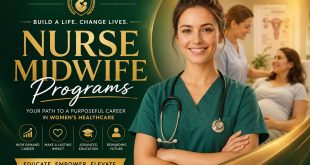
Accredited universities across the United States offer specialized midwifery training programs that combine theory with hands-on experience. A closer look at available options can be explored through this overview of accredited certified nurse midwife programs.
Certification, Licensing, and Professional Readiness
Completing graduate education is only one milestone. To practice professionally, candidates must pass the national certification exam administered by the American Midwifery Certification Board (AMCB). This exam evaluates knowledge in pregnancy care, labor management, newborn health, and women’s reproductive medicine.
Once certified, professionals earn the title Certified Nurse Midwife (CNM). Most states in the U.S. require CNMs to maintain both RN licensure and midwifery certification. Continuing education also plays an important role in maintaining professional credentials and staying current with evolving medical standards.
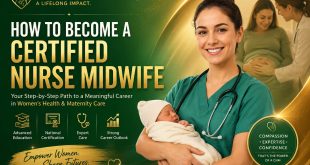
For individuals considering the full journey into this profession, the step-by-step pathway is explained in detail in this guide on how to become a certified nurse midwife.
The professional responsibilities that come after certification are equally important. A clear overview of day-to-day duties can be explored in this detailed breakdown of the certified nurse midwife job description.
Career stability is another reason many nurses pursue this specialty. Salary expectations and long-term career outlook are discussed in this resource covering the typical certified nurse midwife salary in the United States.
FAQ Certified Nurse Midwife Education
- How long does Certified Nurse Midwife education usually take?
The timeline depends on a student’s starting point. Most candidates begin with a Bachelor of Science in Nursing, which typically takes four years. After becoming a licensed registered nurse, they enroll in a graduate nurse-midwifery program that usually requires two to three additional years. When clinical training, certification exams, and licensing are included, the full educational pathway commonly spans six to seven years before someone is fully qualified to practice as a Certified Nurse Midwife. - Can someone become a Certified Nurse Midwife without a nursing background?
Yes, but the path is slightly longer. Many universities offer bridge or accelerated programs for students who hold a bachelor’s degree in another field. These programs allow individuals to earn RN licensure before entering graduate midwifery education. Although the academic workload can be intense, these programs make it possible for motivated career changers to transition into nurse-midwifery within three to four years. - Is Certified Nurse Midwife education difficult?
The academic and clinical expectations are challenging because midwives manage both routine pregnancies and complex maternal health situations. Students must understand advanced physiology, pharmacology, and neonatal care while developing strong clinical judgment. However, many graduates describe the training as deeply rewarding. The combination of scientific learning and meaningful patient relationships often makes the effort worthwhile.
Certified Nurse Midwife education builds far more than technical skill. It shapes healthcare professionals who guide families through one of life’s most meaningful moments. With strong academic preparation, extensive clinical experience, and national certification, CNMs play a vital role in improving maternal care while bringing a uniquely human approach to modern healthcare.
Apply