Info Hot Job Find your dream job! Get for jobs, post your resume, compare salaries and find career advice and research.
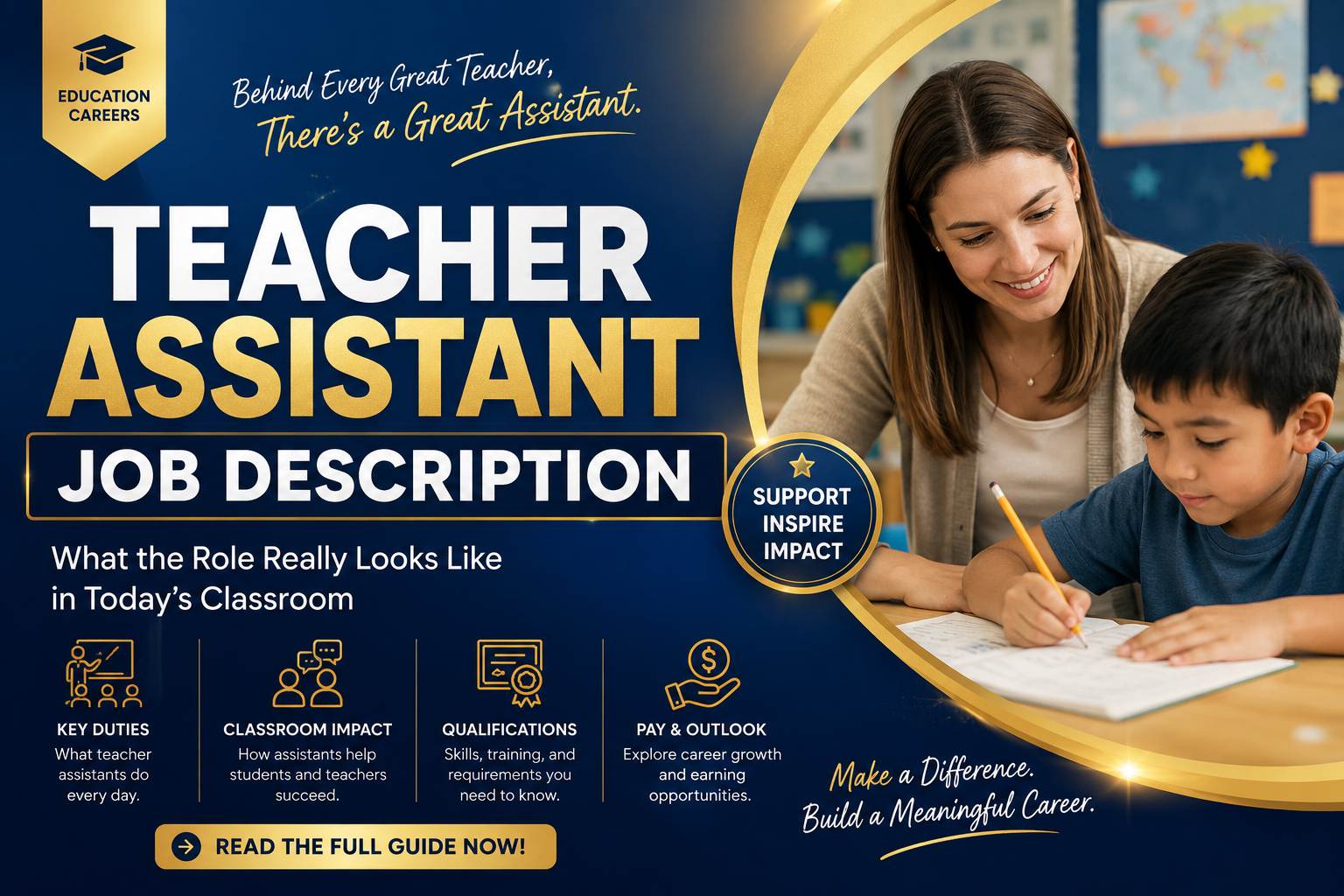
A teacher assistant rarely gets to have a predictable day. One moment, the job may involve helping a student understand a difficult assignment; minutes later, the assistant may be managing a classroom transition, preparing materials, or supporting a student who needs individual attention. The title sounds simple, but the work sits at the intersection of instruction, supervision, communication, and student care.
That’s why a useful Teacher Assistant Job Description needs to go beyond generic phrases such as “assist the teacher” or “support students.” Those descriptions don’t tell applicants what schools actually expect when the classroom gets busy.
If you’re comparing available positions, reviewing current teacher assistant jobs can also show how schools describe responsibilities, qualifications, and working environments in actual vacancies.
Teacher Assistant Job Description and the Reality of Classroom Work
The teacher remains responsible for instruction, but a teacher assistant helps make that instruction workable for students with different abilities, learning speeds, and behavioral needs. The U.S. Bureau of Labor Statistics describes the position as working with a licensed teacher to give students additional attention and instruction, with duties that can include reinforcing lessons, supervising students, preparing materials, and assisting with records.
In practice, much of the job happens in the gaps between the teacher’s lesson plan and a student’s actual response. A student may understand a concept after hearing it explained once, while another may need a quieter explanation, another example, or guided practice. The assistant can provide that extra layer of support without interrupting the entire class.
This makes observation an important part of the role. A good assistant pays attention to more than whether an assignment is finished. Body language, frustration, lack of participation, repeated mistakes, and sudden changes in behavior can all signal that a student needs help.
Communication with the classroom teacher is equally important. Teacher assistants may share observations about student progress, discuss difficulties, or provide feedback after working with an individual student or small group. BLS specifically identifies communication and interpersonal skills as important qualities for the occupation.
Teacher Assistant Duties in Different Classroom Situations
The work changes considerably depending on where the assistant is assigned. In an elementary classroom, the day may involve helping younger students follow routines, complete basic assignments, transition between activities, and remain engaged. In middle or high school, the emphasis may shift toward academic assistance, classroom organization, laboratory activities, technology, or student supervision.
Some assistants work in specialized settings. A teacher assistant may support students in a computer laboratory, library, cafeteria, or other school environment rather than spending the entire day beside one classroom teacher. Childcare settings can also involve feeding, play supervision, and other forms of basic care.
Special education can make the responsibilities substantially more personal and demanding. Some teacher assistants work exclusively with students who have disabilities. Their duties may include helping students access classroom material, adapting how information is presented, assisting with daily activities, or supporting students with more significant needs.
Federal special education regulations allow appropriately trained and supervised paraprofessionals and assistants to help provide special education and related services, but states retain an important role in determining applicable qualifications and requirements.
That distinction matters. A teacher assistant isn’t simply an extra adult who can independently make educational decisions. The position operates within the school’s established structure and under appropriate professional direction. Knowing where assistance ends and the teacher’s responsibility begins is part of doing the job properly.
Teacher Assistant Responsibilities Beyond Instruction
Not every important task happens while students are working on an assignment. Classroom preparation can take a surprising amount of time. Materials may need to be organized before a lesson, equipment prepared, papers distributed, technology checked, or the classroom rearranged for a particular activity.
Student supervision is another major responsibility. Assistants may help during lunch, recess, transitions, field trips, or transportation-related activities. These periods can be less predictable than classroom instruction because students aren’t necessarily sitting quietly at their desks.
Recordkeeping may also be part of the position. Depending on the school, an assistant can help with attendance, grades, classroom documentation, or information used by the teacher to monitor student progress. The specific administrative duties vary, but attention to detail remains essential.
There is also a human side to the work that a formal job posting may not capture. Students can become frustrated, distracted, anxious, or disruptive. An effective assistant doesn’t respond to every difficult moment in the same way. The response needs to fit the student’s age, situation, classroom expectations, and instructions from the teacher.
This is where patience becomes a practical job skill rather than a personality trait. The assistant may need to repeat directions, redirect behavior, change the way an explanation is delivered, or give a student enough space to regain focus.
Candidates who are also evaluating the financial side of the profession can review current information about teacher assistant pay, particularly when comparing positions in different locations.
What Schools Look for in a Teacher Assistant
Schools aren’t simply looking for someone who enjoys being around children. They need people who can function reliably inside a structured educational environment.
Clear communication is essential because the assistant has to understand instructions from teachers and communicate appropriately with students and, in some circumstances, parents or other school personnel. Poor communication can create confusion quickly, especially when several students need assistance at the same time.
Reliability matters just as much. A classroom teacher may plan activities around having another adult available. If that support isn’t dependable, the entire classroom routine can become harder to manage.
Flexibility is another major advantage. A carefully planned school day can change because of student behavior, schedule adjustments, unexpected absences, technology problems, or a lesson that simply isn’t working. Teacher assistants need to adapt without losing sight of the teacher’s instructions.
The ability to maintain professional boundaries is also critical. An assistant may develop strong relationships with students, but those relationships still need to remain appropriate and consistent with school policies.
For candidates interested in working with students who have disabilities, preparation can be especially important. Reviewing teacher assistant certification requirements can help applicants understand why qualifications may differ between states, districts, and specific assignments.
IDEA requires personnel involved in special education to be appropriately prepared and trained, while paraprofessionals and assistants must meet applicable state requirements and receive appropriate supervision.
The setting can also influence what an employer expects. Someone interested in creative classroom environments, for example, may find that art teacher assistant jobs emphasize different classroom activities and student support needs than a general elementary assignment.
Specific district vacancies are worth examining closely because the title alone doesn’t reveal the complete scope of a position. A real example is the Park Hill School District teacher assistant position in Kansas City, Missouri, where the employer’s own requirements and assignment details provide a more concrete picture of what a particular school may expect.
FAQ Teacher Assistant Job Description
- What is the main purpose of a teacher assistant?
The primary purpose is to provide additional support that helps students benefit from classroom instruction while working under the direction of the teacher. That support can involve academic assistance, classroom routines, supervision, preparation, documentation, or individualized help. The exact responsibilities depend on the school, grade level, student population, and assignment.
- Does a teacher assistant teach students independently?
Usually, a teacher assistant reinforces and supports instruction rather than replacing the licensed teacher. The assistant may review material with a student, work with a small group, explain directions, or provide practice, but the scope of responsibility depends on school and state requirements. Special education duties also require appropriate training and supervision under applicable rules.
- What makes a teacher assistant effective in the classroom?
An effective teacher assistant combines patience with strong observation, communication, reliability, and practical judgment. The best assistants notice when students are struggling, respond without unnecessarily disrupting the class, follow the teacher’s direction, and communicate useful observations. They also understand that student support involves behavior, routines, safety, and classroom relationships—not just academic assignments.
A Teacher Assistant Job Description should reflect the actual complexity of the position. The work isn’t limited to handing out materials or helping students finish worksheets. It involves responding to individual needs while keeping pace with the larger classroom, supporting the teacher without overstepping professional boundaries, and handling situations that rarely appear in a simplified job summary.
For someone considering this career, that reality is important. The role can be demanding, but it can also provide direct experience with teaching, student development, classroom operations, and inclusive education. Candidates who understand those expectations before applying are more likely to find a position that matches their skills—and to become the kind of support a classroom genuinely needs.