Info Hot Job Find your dream job! Get for jobs, post your resume, compare salaries and find career advice and research.
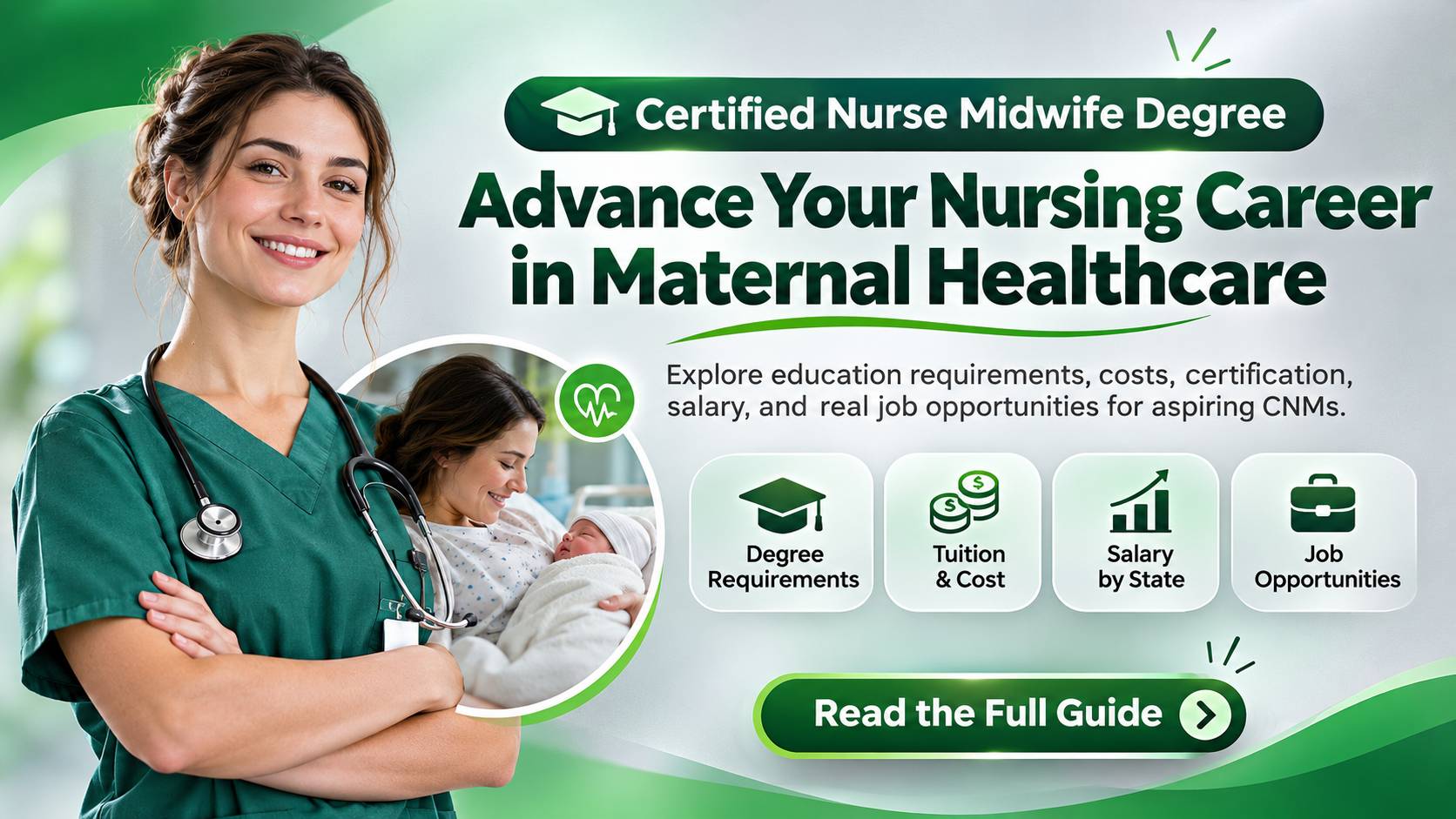
For registered nurses who want to advance their careers in women’s healthcare, becoming a Certified Nurse Midwife (CNM) offers a specialized professional pathway. The role goes far beyond assisting with childbirth. CNMs provide prenatal care, support patients during labor and recovery, manage reproductive health needs, and help women make informed decisions about their healthcare.
The need for qualified maternal healthcare professionals makes this career an attractive option. Yet getting there takes considerable preparation. A Certified Nurse Midwife Degree requires graduate-level education, supervised clinical experience, professional certification, and state licensing. Tuition can be substantial, and employment opportunities differ considerably across the United States. Before committing to this qualification, prospective students should consider whether the educational investment aligns with their professional ambitions and the realities of the job market.
What Is a Certified Nurse Midwife Degree?
A Certified Nurse Midwife Degree is an advanced nursing qualification that prepares registered nurses to provide comprehensive maternity and reproductive healthcare. It develops the clinical judgment needed to care for patients throughout pregnancy, childbirth, postpartum recovery, and other stages of reproductive life.
Most aspiring CNMs pursue a Master of Science in Nursing (MSN) or Doctor of Nursing Practice (DNP) with a nurse-midwifery specialization. Both pathways provide advanced clinical education, although program structure, academic expectations, and completion requirements vary between universities.
Coursework commonly covers advanced physiology, pharmacology, prenatal assessment, labor management, newborn care, postpartum recovery, and evidence-based clinical practice. Students also complete supervised clinical rotations, where they apply their knowledge in actual healthcare environments. This practical component is essential. Understanding obstetric complications in a classroom is one thing; recognizing clinical warning signs and responding appropriately during patient care requires hands-on preparation.
It’s important to distinguish an academic degree from professional certification. Completing graduate education alone doesn’t automatically qualify someone to use the CNM credential. Graduates must satisfy the applicable eligibility requirements and pass the national certification examination administered by the American Midwifery Certification Board (AMCB).
Accreditation deserves equal attention. Prospective students should check whether a program holds accreditation from the Accreditation Commission for Midwifery Education (ACME) and meets current certification eligibility requirements. Choosing a program without verifying these details can create unnecessary difficulties when graduates are ready to pursue certification.
Certified Nurse Midwife Degree Requirements and Career Opportunities
The conventional educational route begins with a Bachelor of Science in Nursing (BSN) and an active registered nurse (RN) license. Applicants then pursue admission to a graduate nurse-midwifery program. Universities may request academic transcripts, professional references, a personal statement, and evidence of relevant nursing experience.
Not every applicant follows the same route. Some universities offer bridge pathways for registered nurses with associate degrees or nursing diplomas. Depending on the institution, an RN-to-MSN program or additional undergraduate coursework may be necessary before completing advanced practice preparation.
For nurses entering with a BSN, full-time graduate education generally takes around two to three years, although this is an estimate rather than a universal requirement. Part-time enrollment can extend that period, particularly when clinical rotations and academic schedules are difficult to coordinate with existing employment.
Working nurses who need flexibility may consider Certified Nurse Midwife Programs Online. These programs can reduce the need to attend campus regularly, but they don’t remove clinical training requirements. Students still need supervised patient-care experience, and finding an approved clinical placement near their location can become one of the biggest practical challenges of distance education.
Once qualified and certified, CNMs can seek employment in hospitals, birth centers, women’s health clinics, physician practices, and community healthcare organizations. Their responsibilities include prenatal examinations, maternal and fetal monitoring, management of normal labor and delivery, postpartum assessments, and reproductive health services.
The working environment can make a significant difference to daily responsibilities. Hospital-based CNMs may handle rotating shifts, overnight coverage, weekend schedules, and coordination with obstetricians and other specialists. Birth centers and outpatient practices may offer different working arrangements, although patient care still requires careful assessment, clinical documentation, and the ability to recognize complications that need referral or emergency intervention.
The scope of the job is broader than many prospective students initially realize. A CNM must communicate with patients, interpret clinical findings, maintain accurate medical records, coordinate treatment, and make sound clinical decisions. A closer look at what a Certified Nurse Midwife does helps clarify the responsibilities involved in everyday practice.
The employment picture deserves a realistic assessment. Holding a graduate degree doesn’t guarantee a job immediately after graduation. Hospitals and established healthcare organizations may favor applicants with labor and delivery experience, strong clinical references, current certification, and the ability to work within multidisciplinary teams.
Location can also make a substantial difference. Major metropolitan areas often have larger healthcare networks and more potential employers, but competition for desirable positions can be intense. Rural communities may have significant gaps in maternity services, although fewer facilities and limited staffing resources can affect available positions.
For this reason, checking actual job advertisements before enrolling is a sensible step. Look beyond salary figures and examine whether employers require previous CNM experience, specific clinical competencies, prescribing qualifications, or particular state licenses. These details provide a much clearer picture of the opportunities waiting after graduation.
Certified Nurse Midwife Degree Cost, Salary, and Certification
Graduate nursing education involves more than tuition payments. Students may need to budget for textbooks, examination fees, clinical travel, professional insurance, and other program-related expenses. The total cost depends on the university, residency status, number of credits, and length of enrollment.
Financial aid, scholarships, employer tuition reimbursement, and federal student aid may help eligible applicants manage the expense. Nurses who intend to continue working while studying should also consider whether their schedules will allow them to complete demanding clinical rotations without affecting their income.
Salary potential is an important part of the decision. Certified nurse midwife compensation varies by state, experience, employer, and clinical responsibilities. Hospital positions may include night shifts, weekend coverage, or on-call duties, while outpatient practices may have different scheduling arrangements and compensation structures.
The Certified Nurse Midwife Salary by State resource provides a useful starting point for comparing regional earning potential.
Still, the highest advertised salary isn’t automatically the best opportunity. A position offering higher compensation may involve a demanding schedule, expensive housing, longer commuting distances, or greater clinical responsibilities. Educational debt also matters. Comparing expected income with living expenses and total education costs gives a more realistic view of the financial return.
Certification is the next major milestone after graduate education. Eligible graduates generally apply for the AMCB national certification examination. Passing this examination is required to obtain the Certified Nurse Midwife credential.
State licensure is a separate requirement. National certification demonstrates that a practitioner has met professional standards, but state licensing determines the legal authority to practice. Rules concerning prescribing privileges, physician collaboration, and independent practice differ across jurisdictions.
Anyone planning to work in a particular state should review its current licensing requirements before choosing a program. The Certified Nurse Midwife Training pathway offers additional context about the preparation needed to enter this profession.
Another point worth understanding is the difference between a Certified Midwife (CM) and a Certified Nurse Midwife (CNM). The two credentials are not interchangeable. CNMs follow a nursing-based educational pathway that includes RN preparation and graduate nurse-midwifery education, whereas CMs follow a different educational route. Reviewing Certified Midwife vs. Certified Nurse Midwife can help applicants avoid choosing a qualification that doesn’t match their intended career pathway.
A strong professional profile combines an eligible graduate degree, national certification, relevant clinical experience, and compliance with state licensing regulations. Employers evaluate the complete qualification, not simply the name of the university attended.
FAQ: Certified Nurse Midwife Degree
1. How many years does it take to earn a Certified Nurse Midwife Degree?
For registered nurses who already hold a BSN, a full-time graduate nurse-midwifery program generally takes around two to three years. Part-time enrollment, bridge pathways, and additional clinical requirements may extend the timeline. Students should also account for certification and state licensing procedures, since completing the academic program is only one stage of becoming eligible to practice professionally.
2. Can you earn a Certified Nurse Midwife Degree entirely online?
Some universities offer online or hybrid nurse-midwifery programs, allowing students to complete much of their academic coursework remotely. However, clinical education still requires supervised, hands-on experience in approved healthcare settings. Before applying, check ACME accreditation, AMCB certification eligibility, state authorization, and whether the university can arrange suitable clinical placements near your location.
3. What is the difference between an MSN and a DNP for nurse-midwifery?
An MSN and a DNP are both graduate-level educational pathways, but they differ in academic depth and focus. An MSN generally prepares nurses for advanced clinical practice, while a DNP includes additional emphasis on clinical leadership, healthcare systems, quality improvement, and evidence-based practice. Both may lead to nurse-midwifery certification eligibility when the program meets applicable accreditation and AMCB requirements. Prospective students should compare curriculum, tuition, clinical arrangements, and career objectives before selecting a pathway.
A Certified Nurse Midwife Degree can open the door to advanced nursing practice and a specialized career in maternal and reproductive healthcare. But the decision shouldn’t rest on professional recognition or salary expectations alone. The educational commitment, clinical workload, certification process, and state licensing requirements all deserve careful consideration.
For registered nurses who genuinely want to work in this field, the strongest starting point is a clear understanding of the local employment market and the qualifications employers expect. Choosing an appropriately accredited program and gaining relevant clinical experience can make a meaningful difference when entering the profession.
The opportunity is there, but preparation matters. A well-planned educational pathway gives aspiring CNMs a stronger foundation for building a sustainable career while contributing to better maternal healthcare across the United States.